Showing posts with label Culture. Show all posts

Wednesday, December 31, 2014

Lahore - off the beaten track

It’s a common lament but modern Lahoris are largely indifferent to their glorious history. For most affluent residents of the city a culinary visit to Cooco’s or Andaaz with their majestic rooftop views of the 17th century Badshahi Mosque suffice as a representative cultural experience, before they beat a hasty retreat to the attractions of the Y Block market. But beyond the well-known spectacular treasures of Lahore’s heritage (Lahore Fort, Badshahi Mosque, Shalamar Gardens, Lahore Museum, Masjid Wazir Khan etc.), all of which are well worth discovering and rediscovering, there are hundreds of amazing places, in and outside the walled city, that tell “tales without end” of Lahore’s fascinating past. Here is a smattering of some of my favorite, less frequently visited, historic sites.
Shrines:
Entrance to the shrine of Syed Hussain Zanjani
Legend has it that the patron saint of Lahore, Data Ganj Bakhsh (d. 1072), arrived in Lahore the day another revered saint, Syed Hussain Zanjani, died. The shrine of Syed Hussain Zanjani is located in the Chah Miran area, and once found with some difficulty, is an oasis of tranquility and spiritual quiet in an area otherwise bustling with commercial activity. There is a spot that marks the place where the famous saint Khawaja Mueenuddin Chishti of Ajmer (Rajasthan) prayed at the shrine when he visited Lahore.
Not far from Syed Hussain Zanjani’s tomb, is one of the most wonderful shrines in the city: the 16th century Mazar of the child saint Ghoray Shah. As you enter the gateway, you see the stall selling toy clay horses that devotees buy as an offering for the saint. The child saint Syed Burhanuddin Ghoray Shah, who loved horses, was believed to have miraculous powers. People who brought him gifts of a toy horse had all their wishes fulfilled. It is said that Ghoray Shah was heart-broken after being scolded by his pious father for granting favors in exchange for toys and died at age five. Four hundred years later, devotees are still bringing toy horses for the saint to seek his favor and to have him intercede on their behalf. The enclosure is peaceful and cool with the shade of old trees. Toy clay horses can be seen placed near the saint’s grave on a raised platform as well as along the graveyard fence.
 
Ghoray Shah Shrine - Toy horses can be seen on the platform in the background
The history of darbaars, mazaars and dargaahs of Lahore can fill volumes. Leaving out Mian Mir (in whose adjacent graveyard I fortuitously found the gravesite of poet Faiz’s beloved older brother Tufail with an inscription of Faiz’s famous verses “Mujh ko shikwa hai meray bhai keh tum jaate hue”) or Madho Lal Hussain seems egregiously wrong but we must move on.

Poet Faiz Ahmed Faiz's brother's tombstone inside Mian Mir's shrine
Havelis:
The walled city had many grand havelis for the intellectual and ruling elites of the city and despite the loss of many historic structures due to official neglect, fortunately, some major havelis are still extant. Despite not being in great condition, Mubarak Haveli in Kucha Chabaksawaran inside Mochi Gate is well worth a visit. It is owned by the Qizilbash family now, having been granted to them for their services to the British. Its fascinating history includes being the temporary residence of the Afghan king Shah Shuja Durrani when he was in exile in Lahore in 1813 / 1814. It is in this haveli that he surrendered the Kohinoor diamond to Maharaja Ranjit Singh in exchange for his freedom. Kohinoor, later taken by the British now forms part of the British Crown Jewels at the Tower of London.
 
Exterior of Mubarak Haveli
Just down the street from the Mubarak haveli in Mochi Darwaza is another Qizilbash property called Nisar Haveli, famous for being the starting point of Lahore’s Muharram procession. The procession starts there and after winding its way through the walled city eventually ends on the evening of 10th Muharram at Karbala Gamay Shah next to the Central Model School not far from the Government College. Beyond its religious and cultural significance, Karbala Gamay Shah is also interesting as the burial place of the great Urdu writer and scholar Muhammad Hussain Azad (who died in Lahore in 1910). Azad’s book Aab-e-Hayat (published in 1880) on Urdu poets and poetry is considered one of the pioneering works of its genre. The site in the back courtyard is marked by a brick structure with a white dome.
Nisar Haveli Courtyard
 
Tomb of Urdu writer Muhammad Hussain Azad in Karbala Gamay Shah
Unfortunately, I have not yet had the opportunity to see, reputedly, the two best maintained grand havelis in the city; Haveli Baroodkhana (owned by the Mian family) and ‘Mubarak Begum’ haveli (owned by the Syed family).
Mosques:
Interior of Begum Shahi Mosque
Anyone who has not visited Masjid Wazir Khan inside Delhi Gate must first visit that gem of Lahore’s architecture. But inside the walled city another lesser known mosque should attract many more visitors. Entering androon shehr from Masti Gate, you will find the oldest extant Mughal mosque in Lahore, the Maryam Zamani or Begum Shahi Mosque, built in 1614. This beautiful mosque close to the Akbari Gateway entrance of the Lahore Fort was built by Emperor Jahangir’s mother who was known as Maryam-uz-zamani (Mary of her age). This wife of Emperor Akbar and mother of Jahangir, born Rajkumari Hira Kunwari, was a Rajput princess and the daughter of Raja Bihari Mal of Amber (now Jaipur). Its prayer hall is beautifully decorated and the central dome remarkable for the richness of its muqarnas and painted frescos.
 
Sikh Monuments:


Gurdwara Janam Asthan Guru Ram Das Ji
Lahore has a rich array of well-known Sikh era buildings like havelis (e.g. Mai Jindan haveli, Haveli Naunehal Singh, now Victoria Girls School), Samadhis (e.g. Maharaja Ranjit Singh) and Gurdwaras (e.g. Dera Sahib in the same compound as Ranjit Singh samadhi) but a lesser known Gurdwara inside the walled city bears mention. In Kotwali Wala Bazaar near Chuna Mandi Chowk in Kashmiri Gate is the “Gurdwara Janam Asthan of Guru Ram Das Jee”. Guru Ram Das was the fourth of the Ten Gurus of Sikhism and was born in Chuna Mandi in 1534. He founded the original township which became the Sikh holy city of Amritsar. The Gurdwara is in good condition and is actively used by the Sikh community. Sikh volunteers keep the structure well-maintained.
With every visit to the historic Lahore, I find, that more and more historical buildings are suffering from neglect or worse, being destroyed. Just last month on a visit to the beautiful Dai Anga Mosque (built in 1649), I was heartbroken to see that the original interior of the mosque had been scraped and ripped out and was being replaced by white bathroom tiles on cement, completely destroying the historic structure. The sign in the mosque’s courtyard calling it a “protected monument” seemed like a cruel joke. To effectively protect a city or nation’s history, culture and heritage its people and governments have to know, care for and value their treasures.
For those interested in exploring the great city of Lahore, I highly recommend getting Yasmeen Lari’s “Lahore Travel Guide”. It is meticulously researched and is a treasure trove of Lahore’s history and heritage. The hand-drawn maps of the walled city are painstakingly done. As a native of Lahore who was unaware of many corners of my own city’s history for too long, I must thank Ms. Lari for this outstanding labour of love.

This post was originally published in the March 28th, 2014 issue of The Friday Times.

Saturday, April 19, 2008

Dalrymple on "The Arts of Kashmir"

William Dalrymple has a good essay in this issue of the NYRB on Asia Society's exhibition catalog by Pratapaditya Pal on "The Arts of Kashmir".

The first part of the essay describes the sad devastation of the Kashmir Valley and the destruction of Kashmir's traditionally peace loving and syncretic culture. No matter where one places the blame for this long and deadly conflict, the clash of nationalisms that has played out in Kashmir has ravaged the Kashmiris with no end in sight for this strife torn people.

The exhibition catalog and Dalrymple's essay serves to remind the audience of the historic cultural vitality of Kashmir with its rich Hindu, Buddhist and Muslim past. I particularly enjoyed reading about the early Kashmiri Muslim ruler Zain-ul-Abidin "Budshah" (1420-1470) who was renowned for his artistic patronage and whose 50 year reign is still remembered fondly by Kashmiris despite the passage of 500 years:
Fluent in Kashmiri, his native tongue, and Persian, Sanskrit, and Tibetan, he was a great patron of the arts and architecture, of literature and music, and in the conservation and preservation of Kashmir's heritage, irrespective of his religious affiliation.... Indeed, the only other Muslim ruler on the subcontinent who can be compared to Zain-ul-Abidin for his liberality, his intellectual curiosity, his love of learning as well as music, and for introducing and nourishing a wide range of crafts and arts and architecture is the Mughal emperor Akbar (1556–1605).
One can only hope that Kashmiris and their land are spared further destruction and they gradually find a way back to a culture "of tolerance and syncretism so clearly exemplified in Kashmir's artistic traditions".

Photograph: Shiva and his consort Parvati (ca. 900 AD)

Friday, August 03, 2007

Bob Dylan in Concert

Last weekend, I was thrilled to be a part of a memorable musical experience when I saw Bob Dylan perform live in concert for the first time. Dylan performed in Kelseyville, California about a 150 mile drive from where I live in the San Francisco Bay area. The venue was the charming 5,000-person capacity Konocti Outdoor Amphitheater on the banks of the Clear Lake. It was a beautiful, warm summer evening and the concert was an absolute treat.

I certainly cannot claim to be one of those lifelong Dylan fans who know the lyrics to every Dylan song and can reliably narrate every twist and turn of his long and remarkable performing career but I have been an admirer of his music and songwriting for a long time. Some of Dylan's songs such as "It's all over now, baby blue" and "Shelter from the storm" make the list of my all time favorites. However, to be fair, my desire to see Dylan in concert was also based, in part, on experiencing first hand a performance of this unique 60's counterculture icon.

Dylan is 66 years old and since 1988 has been on a "Never Ending Tour" performing more than 100 concerts a year. His voice is now more gruff and raspy than in his famous studio recordings but it still retains that quintessential raw quality. The performance was extremely lively and energetic. Dylan and his Band have refused to turn these live concerts into nostalgia acts so even the classic oldies are typically performed in newer arrangements. For those like me who don't follow the band around, it would have been nice to hear some of the familiar arrangements for songs like "Blowin' in the wind" but overall it was still an exhilarating experience.

Here's the set that Dylan and the Band played that evening:

1. Leopard-Skin Pill-Box Hat (Bob on electric guitar)
2. It Ain't Me, Babe (Bob on electric guitar)
3. I'll Be Your Baby Tonight (Bob on electric guitar)
4. It's Alright, Ma (I'm Only Bleeding)(Bob on electric guitar)
5. Workingman's Blues #2 (Bob on keyboard)
6. Rollin' And Tumblin' (Bob on keyboard)
7. Boots Of Spanish Leather (Bob on keyboard and harp)
8. Lonesome Day Blues (Bob on keyboard)
9. Desolation Row (Bob on keyboard and harp)
10. Highway 61 Revisited (Bob on keyboard)
11. Spirit On The Water (Bob on keyboard and harp)
12. Stuck Inside Of Mobile With The Memphis Blues Again(Bob on keyboard and harp)
13. Ain't Talkin' (Bob on keyboard)
14. Summer Days (Bob on keyboard)
15. Blowin' In The Wind (Bob on keyboard)
(encore)
16. Thunder On The Mountain (Bob on keyboard)
17. All Along The Watchtower (Bob on keyboard)

(With thanks to Bill Pagel's Bob Dylan tour webpage for details on the set)

Here's one of my Dylan all-time favorites:

Saturday, February 03, 2007

The Inhuman Enemy

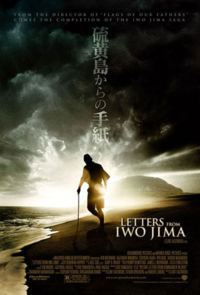
Yesterday I read Ian Buruma's excellent review of Clint Eastwood's new film "Letters from Iwo Jima" in the New York Review of Books. This film, in the Japanese language, has been widely praised by critics, winning the Golden Globe for "Best Foreign Language Film". The passage below in Buruma's review really caught my eye:
"Most war movies have been about heroes, our heroes, and individual differences among the enemies were irrelevant, since their villainy could be taken for granted. In fact, showing individual character, or indeed any recognizable human qualities, would be a hindrance, since it would inject the murderousness of our heroes with a moral ambiguity that we would not wish to see. The whole point of feel-good propaganda is that the enemy has no personality; he is monolithic and thus inhuman."

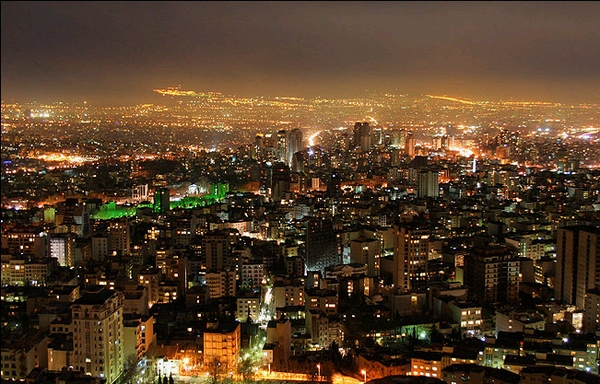
This reminded me of a recent e-mail I had received with a link to an old song by Cat Stevens (Yusuf Islam nowadays) called "Peacetrain". The song is in the background as images of modern day Tehran flash on the screen. These images of everyday life paint a portrait of a people not unlike 'us' as opposed to pictures of an implacably ugly and hostile enemy conjured up by political propaganda. How many people visualize Tehran and its people in this way when they speak of bombings and military action? The message is powerful and surprisingly effective in its simplicity because it subverts the very essence of propaganda, the inhumanity of the 'other'.

Thursday, July 06, 2006

Garrison Keillor - The Man from Lake Wobegon

I have been a fan of Garrison Keillor's radio show, The Prairie Home Companion, for several years now but I have never been able to pinpoint the show's precise charm. Somehow a wonderful broadcast is created by the combination of Keillor's soothing, pitch perfect radio voice, the melodious, pastoral folk music and the show's general atmosphere which transports the audience to a time, place and rhythm of life that the frenzied modern soul yearns for. This magical atmosphere is given concrete shape by Keillor's unendingingly fascinating, everyday vignettes of his midwestern "hometown" of Lake Wobegon; the town where "all the women are strong, all the men are good looking and all the children are above-average".

Sam Anderson wrote a wonderfully insightful piece about Garrison Keillor not so long ago that is a must read for afficionados.

Saturday, February 04, 2006

Memories of old Bollywood

Khalid Hasan in the Friday Times remembers Nargis, the great Indian actress of the 40's and 50's (full article behind Friday Times' subscription firewall). Khalid Hasan's reminiscenses about film, music, poetry and South Asian personalities and institutions are unfailingly interesting. In a culture where the genre of memoir is so impoverished, his articles are a worthy effort at preserving the memory of many bhoole bisre log.

Some excerpts:

Sunil Dutt buried her, as she had willed, next to her mother Jaddan Bai in Bombay. Her grave bears the name she was given at birth: Kaniz Fatima. Her great friend in Bombay, Qurratulain Hyder, wrote to me after Nargis died: “Yes, Nargis has left us all immeasurably sad. She was a part of the time of our growing up, a time that is itself now mythological. Her old movies, when one watches them on television now, look quite amateurish, but how romantic they seemed then! She moved ahead in life with tremendous grace and dignity. And when she died, she died as a major national figure. She was a fascinating woman who had no hang-ups about her mother’s origins. In fact, the last time she met me, I recall her telling me that her mother was such an independent woman that once when the Nawab of Rampur, who was celebrating his birthday, asked her to dance on a takht-e-rawaan , a platform that moves with a ceremonial procession, she refused. She was a great admirer of her mother and it was her desire that she should lie next to her and among those who stood silently praying as she was being lowered to earth was Sunil Dutt.”

Sunil Dutt, who came from Jhelum, died last year.

Saadat Hasan Manto, recalling his meeting with Nargis in 1946, writes: “There was something very playful and innocent about her. She would blow her nose every few minutes as if she suffered from a permanent cold. This was captured in Barsaat as one of her endearing traits.” He also writes about the two younger sisters of his wife Safia, who while on a visit to Bombay, befriended Nargis. One of the sisters is Zakia, the late Hamid Jalal’s wife and Shahid and Ayesha Jalal’s mother. I asked Zakia Jalal some years ago what she remembered of Nargis. This is what she wrote back: “You have asked me about our meetings with Nargis. I can only tell you that when we saw her first picture Taqdeer, my sister Rafia and I just fell in love with her. The public reaction was that she would not make it to the top because of her looks. People said that she had a long face. Anyway, we sisters were dying to talk to her. We dared not ask Bhai Saadat to get her telephone number for us. We asked Agha Khalish Kaashmiri for it and he got it for us. We called her and we just clicked. We told her that it was difficult for us to visit her, so it would be nice if she could come. She agreed and the very next day, she came to Safia Apa’s house with her mother Jaddan Bai. There was nothing more exciting for us, but that very day, Bhai Saadat decided to come home early. We were terrified but he was very nice to Jaddan Bai and they got along very well.

Saturday, January 21, 2006

International Cinema

Chatting with a friend at work over lunch recently, we somehow ended up on the subject of films. Despite my fondness for good cinema, the conversation with Ranjan reminded me of how few of the films by the iconic filmmakers of international cinema have I actually seen. I have not watched any of the movies by Goddard, Bergman, Bunuel, Kurosawa, Fellini or Malle and only one or two by Truffaut (400 Blows), Hitchcock (Rear Window), Welles (Citizen Kane) , Satyajit Ray (Pather Panchali) and Kubrick (Clockwork Orange).

I am hoping to take more time this year to watch some of the greatest films by the masters. The next few films on my list are The Bicycle Thief (Vittorio de Sica), North by Northwest (Hitchcock), A Bout de Souffle (Godard) and Kurosawa's Rashomon. I hope to be back with my thoughts on these films at some point.