Showing posts with label History. Show all posts

Wednesday, December 31, 2014

Lahore - off the beaten track

It’s a common lament but modern Lahoris are largely indifferent to their glorious history. For most affluent residents of the city a culinary visit to Cooco’s or Andaaz with their majestic rooftop views of the 17th century Badshahi Mosque suffice as a representative cultural experience, before they beat a hasty retreat to the attractions of the Y Block market. But beyond the well-known spectacular treasures of Lahore’s heritage (Lahore Fort, Badshahi Mosque, Shalamar Gardens, Lahore Museum, Masjid Wazir Khan etc.), all of which are well worth discovering and rediscovering, there are hundreds of amazing places, in and outside the walled city, that tell “tales without end” of Lahore’s fascinating past. Here is a smattering of some of my favorite, less frequently visited, historic sites.
Shrines:
Entrance to the shrine of Syed Hussain Zanjani
Legend has it that the patron saint of Lahore, Data Ganj Bakhsh (d. 1072), arrived in Lahore the day another revered saint, Syed Hussain Zanjani, died. The shrine of Syed Hussain Zanjani is located in the Chah Miran area, and once found with some difficulty, is an oasis of tranquility and spiritual quiet in an area otherwise bustling with commercial activity. There is a spot that marks the place where the famous saint Khawaja Mueenuddin Chishti of Ajmer (Rajasthan) prayed at the shrine when he visited Lahore.
Not far from Syed Hussain Zanjani’s tomb, is one of the most wonderful shrines in the city: the 16th century Mazar of the child saint Ghoray Shah. As you enter the gateway, you see the stall selling toy clay horses that devotees buy as an offering for the saint. The child saint Syed Burhanuddin Ghoray Shah, who loved horses, was believed to have miraculous powers. People who brought him gifts of a toy horse had all their wishes fulfilled. It is said that Ghoray Shah was heart-broken after being scolded by his pious father for granting favors in exchange for toys and died at age five. Four hundred years later, devotees are still bringing toy horses for the saint to seek his favor and to have him intercede on their behalf. The enclosure is peaceful and cool with the shade of old trees. Toy clay horses can be seen placed near the saint’s grave on a raised platform as well as along the graveyard fence.
 
Ghoray Shah Shrine - Toy horses can be seen on the platform in the background
The history of darbaars, mazaars and dargaahs of Lahore can fill volumes. Leaving out Mian Mir (in whose adjacent graveyard I fortuitously found the gravesite of poet Faiz’s beloved older brother Tufail with an inscription of Faiz’s famous verses “Mujh ko shikwa hai meray bhai keh tum jaate hue”) or Madho Lal Hussain seems egregiously wrong but we must move on.

Poet Faiz Ahmed Faiz's brother's tombstone inside Mian Mir's shrine
Havelis:
The walled city had many grand havelis for the intellectual and ruling elites of the city and despite the loss of many historic structures due to official neglect, fortunately, some major havelis are still extant. Despite not being in great condition, Mubarak Haveli in Kucha Chabaksawaran inside Mochi Gate is well worth a visit. It is owned by the Qizilbash family now, having been granted to them for their services to the British. Its fascinating history includes being the temporary residence of the Afghan king Shah Shuja Durrani when he was in exile in Lahore in 1813 / 1814. It is in this haveli that he surrendered the Kohinoor diamond to Maharaja Ranjit Singh in exchange for his freedom. Kohinoor, later taken by the British now forms part of the British Crown Jewels at the Tower of London.
 
Exterior of Mubarak Haveli
Just down the street from the Mubarak haveli in Mochi Darwaza is another Qizilbash property called Nisar Haveli, famous for being the starting point of Lahore’s Muharram procession. The procession starts there and after winding its way through the walled city eventually ends on the evening of 10th Muharram at Karbala Gamay Shah next to the Central Model School not far from the Government College. Beyond its religious and cultural significance, Karbala Gamay Shah is also interesting as the burial place of the great Urdu writer and scholar Muhammad Hussain Azad (who died in Lahore in 1910). Azad’s book Aab-e-Hayat (published in 1880) on Urdu poets and poetry is considered one of the pioneering works of its genre. The site in the back courtyard is marked by a brick structure with a white dome.
Nisar Haveli Courtyard
 
Tomb of Urdu writer Muhammad Hussain Azad in Karbala Gamay Shah
Unfortunately, I have not yet had the opportunity to see, reputedly, the two best maintained grand havelis in the city; Haveli Baroodkhana (owned by the Mian family) and ‘Mubarak Begum’ haveli (owned by the Syed family).
Mosques:
Interior of Begum Shahi Mosque
Anyone who has not visited Masjid Wazir Khan inside Delhi Gate must first visit that gem of Lahore’s architecture. But inside the walled city another lesser known mosque should attract many more visitors. Entering androon shehr from Masti Gate, you will find the oldest extant Mughal mosque in Lahore, the Maryam Zamani or Begum Shahi Mosque, built in 1614. This beautiful mosque close to the Akbari Gateway entrance of the Lahore Fort was built by Emperor Jahangir’s mother who was known as Maryam-uz-zamani (Mary of her age). This wife of Emperor Akbar and mother of Jahangir, born Rajkumari Hira Kunwari, was a Rajput princess and the daughter of Raja Bihari Mal of Amber (now Jaipur). Its prayer hall is beautifully decorated and the central dome remarkable for the richness of its muqarnas and painted frescos.
 
Sikh Monuments:


Gurdwara Janam Asthan Guru Ram Das Ji
Lahore has a rich array of well-known Sikh era buildings like havelis (e.g. Mai Jindan haveli, Haveli Naunehal Singh, now Victoria Girls School), Samadhis (e.g. Maharaja Ranjit Singh) and Gurdwaras (e.g. Dera Sahib in the same compound as Ranjit Singh samadhi) but a lesser known Gurdwara inside the walled city bears mention. In Kotwali Wala Bazaar near Chuna Mandi Chowk in Kashmiri Gate is the “Gurdwara Janam Asthan of Guru Ram Das Jee”. Guru Ram Das was the fourth of the Ten Gurus of Sikhism and was born in Chuna Mandi in 1534. He founded the original township which became the Sikh holy city of Amritsar. The Gurdwara is in good condition and is actively used by the Sikh community. Sikh volunteers keep the structure well-maintained.
With every visit to the historic Lahore, I find, that more and more historical buildings are suffering from neglect or worse, being destroyed. Just last month on a visit to the beautiful Dai Anga Mosque (built in 1649), I was heartbroken to see that the original interior of the mosque had been scraped and ripped out and was being replaced by white bathroom tiles on cement, completely destroying the historic structure. The sign in the mosque’s courtyard calling it a “protected monument” seemed like a cruel joke. To effectively protect a city or nation’s history, culture and heritage its people and governments have to know, care for and value their treasures.
For those interested in exploring the great city of Lahore, I highly recommend getting Yasmeen Lari’s “Lahore Travel Guide”. It is meticulously researched and is a treasure trove of Lahore’s history and heritage. The hand-drawn maps of the walled city are painstakingly done. As a native of Lahore who was unaware of many corners of my own city’s history for too long, I must thank Ms. Lari for this outstanding labour of love.

This post was originally published in the March 28th, 2014 issue of The Friday Times.

Wednesday, March 09, 2011

My Pakistan Photo Journal (Part 2) - The Walled City

February 15th - Inside the Walled City, Lahore:

Went with a friend on a walking tour inside the walled city ('androon shehr'). We entered via Masti Gate from the Minar-e-Pakistan / Badami Bagh side of Circular road and eventually exited from Delhi Gate after going through numerous alleyways and bazaars of the inner city. We stopped along the way to see some mosques and historic buildings and enjoyed a Kulcha/Chhole lunch at the stepped entrance of Sonehri Masjid.

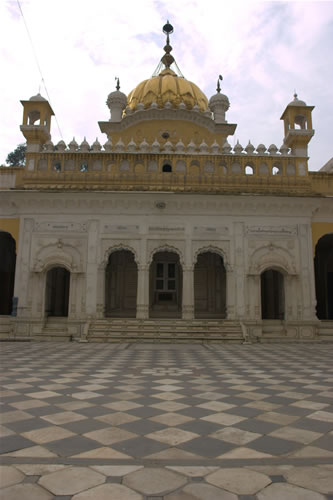
The front courtyard and facade of Begum Shahi Mosque
Entering Masti Gate our first stop was the oldest extant Mughal mosque in Lahore, the Maryam Zamani or Begum Shahi Mosque (above) built in 1614. This beautiful mosque close to the Akbari Gateway entrance of the Lahore Fort was built by Emperor Jahangir's mother who was known as Maryam-uz-zamani (Mary of her age). This wife of Emperor Akbar and mother of Jahangir was a Rajput princess, the daughter of Raja Bihari Mal of Amber (now Jaipur). She was born Rajkumari Hira Kunwari.

In her Lahore Travel Guide, Yasmeen Lari writes: "Comparatively small in size, its present exterior hardly provides the foretaste of the wealth of decoration in the prayer hall. ---The central dome rises above the remaining domes and is carried on a drum; while those on the flanking bays are rather flat hemispherical cupolas. The treatment of the enormous dome itself is remarkable in its muqarnas (stalactite squinches) and elegantly painted fresco network."

The beautiful interior of the dome of Begum Shahi Mosque with its painted frescoes
From the Begum Shahi mosque we stepped into the Masti Gate bazaar and walked south past the dense rows of shops toward Moti bazaar. Many of the bazaars inside the walled city tend to specialize in specific product categories interspersed with food shops. For example, Masti Gate and Moti Bazaar have dozens of footwear shops. Arriving at Chowk Surjan Singh from Moti bazaar we took a left turn onto Hatta bazaar. Continuing on Hatta bazaar we arrived at the junction of Shahalmi bazaar heading south and Dabbi bazaar heading east. At this junction slightly south east is the Kasaira (utensils) bazaar and hidden amongst shops full of shiny pots, pans and pressure cookers is a very narrow entrance to a hidden historic garden called Baoli Ranjit Singh Bagh. This now dilapidated garden once had a stepped well (baoli) where people bathed in the summer months. The baoli marked the residence of Sikhism's fifth guru, Guru Arjun Dev (1563 - 1606). Yasmeen Lari informs us that "later, the well was filled with the debris of Guru Arjun's demolished house and lay uncared for many years. It was restored when an ailing Maharaja Ranjit Singh dreamt that he would recover only after he had taken a bath in the waters of the baoli." The abandoned bagh today with a few young kids playing cricket awaits a modern savior.

Baoli Ranjit Singh Bagh near the junction of Shahalmi and Dabbi Bazaars
There are homes and buildings that surround the Baoli Ranjit Singh Bagh. Standing inside the garden I saw the fascinating facade of the building below ("Gobind Ram Kahan Chand, Estd. 1805, Hindustan Commercial Bank Ltd."). It was puzzling to me how this facade has survived in its current condition because it looks freshly restored. (A bit of Googling revealed that Gobind Ram Kahan Chand was the founder of a company in Lahore in 1805 focused on spreading Ayurveda and its benefits. The company moved to Delhi after partition and is still in business today as GK Herbals.)

Facade of an old building visible from Baoli Ranjit SIngh Bagh
Exiting the bagh we continued our walk east into Dabbi bazaar which is a shopping area popular with women of the walled city with its shops full of crockery, kitchenware and sewing and knitting supplies. It is from Dabbi bazaar near the Kashmiri bazaar chowk that one enters the famous, elevated Sonehri Masjid with its golden domes. This mid-18th century mosque was built by Nawab Bhikari Khan, Governor of Lahore during the time that Mir Mannu was the Mughal ruler of Punjab. Mir Mannu had defeated Ahmad Shah Durrani in 1748 in a battle in Sirhind and remained the Governor of Punjab until his death in 1753.

A view of Sonehri Masjid from the front entrance
Sonehri Masjid was elevated above the shops in Dabbi bazaar with the intention that the rent from the shops below the mosque would provide a steady source of revenue for the mosque's maintenance. For a short while during the reign of Ranjit Singh, the mosque was shut down due to the complaints about disturbance caused by the azan by local Sikhs who had placed the Garanth Sahib in the adjacent baoli mentioned above. The intervention by the Fakir family of Bhati Gate, who had good relations with Ranjit Singh, resulted in the Sikh ruler reversing his decision.

The streets of the walled city were decorated extensively for Eid Milad-un-Nabi (Prophet's birth anniversary)
After enjoying an impromptu lunch from the street vendor at the entrance of Sonehri masjid we continued east through Kashmiri bazaar shops past Chowk Kotwali to the grand Masjid Wazir Khan. Perhaps the finest inner city mosque, Masjid Wazir Khan built in 1634 is an architectural and cultural treasure. It has been extensively photographed and is an oasis of calm in the midst of the bustling walled city. Flocks of pigeons perched on the domes and minarets of the mosque frequently fly over the courtyard from one side of the mosque to the other creating a surreally beautiful environment with the sound of their fluttering wings. Most of the surrounding buildings looking onto the mosque courtyard are residential and fit in seamlessly with the mosque's architecture unlike some other parts of the walled city where ugly new developments sometimes sit in jarring conflict next to sublime monuments.

Entrance gateway and minarets of Wazir Khan mosque as viewed from outside the prayer area entrance
Hakim Aliuddin, the trusted aide of Emperor Shahjahan was granted the title of Wazir Khan in 1620. He became the governor of Punjab in 1632 and left a legacy of numerous monuments, the most famous of which is the Wazir Khan mosque. He also established the town of Wazirabad located 100 km north of Lahore in Gujranwala district. 

Single aisle prayer chamber of Masjid Wazir Khan
After spending some time in the peaceful Wazir Khan mosque we walked south east past the Delhi gate bazaar exiting the walled city via Delhi gate where our car was waiting to transport us back home to a more spacious, amenity-filled but less enchanting Lahore.

To Follow:
Part 3 - Shahdara Monuments
Part 4 - A Visit to Multan
Part 5 - Snapshots of Personal History

Friday, January 02, 2009

Gotham Book Mart's Collection Goes to Penn

Having whiled away many pleasurable hours in antiquarian bookstores, this story about New York's historic Gotham Book Mart caught my eye. The precious collection of books from this bookstore, founded in 1920, will now belong to the University of Pennsylvania thanks to an anonymous benefactor. It is amazing that the entire inventory valued at several million dollars was bought up for a mere $400,000 at auction.

Here's a little excerpt and a photograph from the news story that gives a sense of the bookstore's history:

The Gotham Book Mart was founded on West 45th Street in 1920 by Frances Steloff. It was the haunt of literary figures like Theodore Dreiser, John Dos Passos, H. L. Mencken, Arthur Miller, John Updike, J. D. Salinger and Eugene O’Neill. It exhibited the works of the artist Edward Gorey. Its customers included George and Ira Gershwin, Charlie Chaplin, Alexander Calder, Stephen Spender, Woody Allen, Saul Bellow, John Guare, Katharine Hepburn and Jacqueline Kennedy Onassis. At various points, Allen Ginsberg, LeRoi Jones and Tennessee Williams (for a day) worked as clerks there.

The Gotham Book Mart was famous for its literary eminences. A December 1948 party for Osbert and Edith Sitwell (seated, center) drew a roomful of brightlights to the Gotham Book Mart: clockwise from W. H. Auden, on the ladder at top right, were Elizabeth Bishop, Marianne Moore, Delmore Schwartz, Randall Jarrell, Charles Henri Ford (cross-legged, on the floor), William Rose Benét, Stephen Spender, Marya Zaturenska, Horace Gregory, Tennessee Williams, Richard Eberhart,Gore Vidal and José Garcia Villa. (Photo: Gotham Book Mart)

Saturday, April 19, 2008

Lessons of the Twentieth Century - Tony Judt

Tony Judt is a British Jewish historian specializing in European history. He is currently a professor at New York University and his most recent book was the critically acclaimed history of Europe since 1945 titled "Postwar". Not surprisingly for a historian interested in twentieth century Europe, Judt has reflected deeply and insightfully on war, genocide, occupation, empire and displacement of populations. He regularly writes for the New York Review of Books where many of his past essays are archived here.

His most recent essay titled "What have we Learned, if Anything" in the May 1st issue of the NY Review of Books is an eloquently argued plea to learn the right lessons from perhaps the bloodiest century in human history. Judt argues that, in America in particular, the more distant effects of 20th century suffering and the post cold war triumphalist view of the century's events have led to amnesia about the meaning of war. He calls war the "crucial antecedent condition for mass criminality in the modern era" and goes on to discuss the dangerous consequences for the republic of not learning this crucial lesson from the 20th century. He looks at America's war against terrorism and examines how it displays massive ignorance of the key lessons from the previous century; "the ease with which war and fear and dogma can bring us to demonize others, deny them a common humanity or the protection of our laws, and do unspeakable things to them".

It is always difficult to provide excerpts that would do justice to a well-argued, tight knit essay but here are some passages:

War, in short, prompted behavior that would have been unthinkable as well as dysfunctional in peacetime. It is war, not racism or ethnic antagonism or religious fervor, that leads to atrocity. War—total war—has been the crucial antecedent condition for mass criminality in the modern era. The first primitive concentration camps were set up by the British during the Boer War of 1899–1902. Without World War I there would have been no Armenian genocide and it is highly unlikely that either communism or fascism would have seized hold of modern states. Without World War II there would have been no Holocaust. Absent the forcible involvement of Cambodia in the Vietnam War, we would never have heard of Pol Pot. As for the brutalizing effect of war on ordinary soldiers themselves, this of course has been copiously documented.

The United States avoided almost all of that. Americans, perhaps alone in the world, experienced the twentieth century in a far more positive light. The US was not invaded. It did not lose vast numbers of citizens, or huge swathes of territory, as a result of occupation or dismemberment. Although humiliated in distant neocolonial wars (in Vietnam and now in Iraq), the US has never suffered the full consequences of defeat. Despite their ambivalence toward its recent undertakings, most Americans still feel that the wars their country has fought were mostly "good wars." The US was greatly enriched by its role in the two world wars and by their outcome, in which respect it has nothing in common with Britain, the only other major country to emerge unambiguously victorious from those struggles but at the cost of near bankruptcy and the loss of empire. And compared with other major twentieth-century combatants, the US lost relatively few soldiers in battle and suffered hardly any civilian casualties.
------
Ignorance of twentieth-century history does not just contribute to a regrettable enthusiasm for armed conflict. It also leads to a misidentification of the enemy. We have good reason to be taken up just now with terrorism and its challenge. But before setting out on a hundred-year war to eradicate terrorists from the face of the earth, let us consider the following. Terrorists are nothing new. Even if we exclude assassinations or attempted assassinations of presidents and monarchs and confine ourselves to men and women who kill random unarmed civilians in pursuit of a political objective, terrorists have been with us for well over a century.
------
This abstracting of foes and threats from their context—this ease with which we have talked ourselves into believing that we are at war with "Islamofascists," "extremists" from a strange culture, who dwell in some distant "Islamistan," who hate us for who we are and seek to destroy "our way of life"—is a sure sign that we have forgotten the lesson of the twentieth century: the ease with which war and fear and dogma can bring us to demonize others, deny them a common humanity or the protection of our laws, and do unspeakable things to them.
------
Far from escaping the twentieth century, we need, I think, to go back and look a bit more carefully. We need to learn again—or perhaps for the first time—how war brutalizes and degrades winners and losers alike and what happens to us when, having heedlessly waged war for no good reason, we are encouraged to inflate and demonize our enemies in order to justify that war's indefinite continuance. And perhaps, in this protracted electoral season, we could put a question to our aspirant leaders: Daddy (or, as it might be, Mommy), what did you do to prevent the war?


Update: Just after publishing this post I saw in the April 20th New York Times Book Review, Geoffrey Wheatcroft's review of "Reappraisals", Judt's new collection of essays.

Monday, January 22, 2007

Lahore Revisited

I just returned from a brief trip to Lahore and despite having only a few days there I was able to spend almost a full day inside the enchanting walled city area. I started out at Mori Gate and walked all the way across to Roshnai Gate at the end of Shahi Mohallah Road just past landmarks such as the Mazaar of Hazrat Naugaza Pir and the famous "Phajjay ke Pai" restaurant. Walking through the Roshnai gate I entered the Hazuri Bagh area and past the garden to the entrance of Gurdawara Dera Sahib / Ranjit Singh Smadhi.

The visit to the Gurdawara turned out to be the highlight of my visit. For a long time I have wanted to see this classic Sikh structure but, for reasons unknown, Muslims are not allowed to visit this sacred monument. On a whim I asked a turbaned Sardar standing outside if I could see the Gurdawara. He thought it might be possible and agreed to ask a caretaker. He went inside the complex and returned a few minutes later with an elderly gentleman who after asking me a few questions invited me to come inside. Mr. Harpal Singh was exceptionally kind and gave me a guided tour of the premises, pointing out historic facts about the building. The thing I did not know was that this monument also contains the "Shaheedi Asthan" (the site of martyrdom) of Guru Arjun Dev (the fifth Guru of the Sikhs). Harpal Ji took me to the sacred area where the Guru Granth Sahib is kept and explained the concept of the "Akhand Paath" (the recitation of the entire Granth Sahib in a single setting which can take more than two days). There is an Akhand Paath in the Gurdawara on June 12th, the day of Guru Arjun Dev's martyrdom. Guru Arjun Dev died during the reign of Emperor Jahangir. During his confinement in a prison in the Lahore Fort, the Guru is believed to have vanished into the water miraculously and attained martyrdom after his captors were persuaded to allow him to go bathe in the River Ravi.

After thanking Harpal Ji I walked back into the walled city via Roshnai Gate and winded my way through the streets and alleys all the way to Masjid Wazir Khan inside Delhi Gate passing innumerable shops, bazaars, historic landmarks, shrines, mosques and imambargahs in Mori Gate, Lohari Gate, Shah Alam Bazaar, Mochi Gate and Akbari Mandi. Masjid Wazir Khan is one of the most beautiful and famous mosques in Lahore. It is an oasis of peace set in the midst of crowded bazaars pulsating with constant, loud and hectic commercial activity. In the courtyard of the mosque is the mazaar of the 13th century sufi saint known as Sabz Pir. I sat in the mosque courtyard for a while looking at the delicate decorations on the walls, the surrounding brick buildings overlooking this serene 17th century structure and flocks of pigeons fluttering on the mosque's domes and minarets.

On my way to the walled city I made the essential stop at Kim's; a tiny but wonderful bookstore which is part of the Lahore Museum complex and sits just across from Kim's Gun and Punjab University's Old Campus and adjoins the National College of Arts. I always discover books there that I never find anywhere else in the city. I bought Majid Sheikh's new book called "Lahore: Tales without End" and Som Anand's "Lahore: Portrait of a Lost City". Both books, in very different ways, are treasure troves of vignettes about Lahore and its people. Among dozens of fascinating Lahori tales recounted by Majid Sheikh is the story of the Renault Benz gifted by Adolf Hitler to Allama Mashriqi (founder of the Khaksar Tehreek). This car in a rusted, dilapidated state is still parked in Icchra in the courtyard of Allama Mashriqi's house. Allama's descendants still live in that house.

Sunday, October 01, 2006

Master Madan - Hindustani Music's Child Prodigy

This post owes a direct debt to Bhupinder Singh's recent entry on his blog. It has inspired me to bring together some scattered items about Master Madan.

Since his untimely death as a teenage boy in 1942, Master Madan has had a persistent hold on the imagination of music lovers in the sub-continent. The combination of his virtuosic vocal ability, his hauntingly beautiful voice and the tragedy of such a promising career cut short by premature death have given Master Madan a unique place in the sub-continent's musical memory. The surviving recordings of his music (eight in total) provide music lovers a taste of Master Madan's artistry and give some sense for why he became a phenomenon at such a young age. Bhupinder's piece provides links to two of his best-known recordings. The poet is Sagar Nizami and the music is by Master Amarnath (elder brother of the filmi duo Husanlal-Bhagatram).

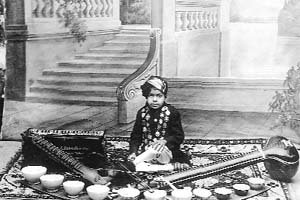
The six other pieces of Master Madan's extant work were introduced by journalist Khalid Hasan in his article in Dawn entitled "The boy with the golden voice" on December 31, 2001. This article also has a great biographical sketch detailing his family background, musical influences and the sad circumstances of his death. The six forgotten recordings were discovered by Khalid Hasan's musicologist friend M. Rafiq. An essay by Pran Neville on Master Madan was published today in India's Sunday Tribune and includes a rare photograph of Master Madan (above and on Bhupinder's post). A lot of the facts in this essay are the same as the Khalid Hasan article but there are a few new interesting details.

I have listened to all six of these recently discovered recordings on the website Thumri.com . Sadly, for quite some time now the links to these recordings on that website no longer work and I hope they will be fixed so we can enjoy these wonderful pieces of music on the internet. More importantly, these recordings should be published so they can get wider circulation. These six pieces include two Punjabi songs; "Ravi de parle kande ve mitra vasda hai dil da chor" and "Baghaan vich peeNgaN PaiyaN". The other four recordings are "Gori gori baiyaaN" and the three bhajans, "Mori binati maano kanha re", "Chetna hai to chet lai" and "Mana ki mana hi maan rahi". The last bhajan (which the website conjectures is in Raag Soraath) is my favorite and is a beautifully melodious piece sung with devotional intensity.

Update: On a recent search on YouTube I found two of Master Madan's ghazals that have been posted by "Rajan". The first ghazal is titled "YuN na reh reh kar HameiN" and the second is "Hairat se tak raha hai jahan-e-wafa mujhe" (title of the second video on YouTube incorrectly has the word "zamana" instead of "jahan-e-wafa"). Enjoy:

YuN na reh reh kar HameiN:


Hairat se tak raha hai jahan-e-wafa mujhe:


Update II: I discovered all known eight songs of Master Madan on this site maintained by Mr. Surjit Singh.

Tuesday, February 07, 2006

Lahore - City of Sin and Splendor

S. Asad Raza's essay on Lahore in http://www.3quarksdaily.com/ posted on their site on Monday, February 6th:

Dispatches: Lahore

Lahore is perhaps the most underappreciated city in the world. The widespread ignorance of the charms of such a beautiful, complicated, and historically important city is sad, though unsurprising, given Western conceptions of the Muslim world - India has droves of tourists, while Pakistan has virtually none. Most of its natives, and most Pakistanis generally, rightly regard it as their country's most cultured metropolis, but even this acclaim does not go far enough. Lahore is the conservatory of a lost world whose traces have been largely erased from more touristic destinations, like Delhi and Agra - I will come to the reasons for this below. The world in general has few cities that interweave so seamlessly a great vitality today (the city is about the twenty-fifth largest on the globe) with an unbroken and luxurious history (spanning the last two millennia). Only in Lahore do you find the sepulcher of the legendary Anarkali, the star-crossed dancing girl buried alive for her love of the young prince Selim (the film Mughal-e-Azam is a version), inside the dusty Archives of the Punjab Secretariat, which was a mosque that the British whitewashed, and is now decorated with portraits of British colonial governors. Layers and layers: it's that kind of place.

Beyond its Mughal grandeur, landscaped gardens, and Sufi shrines, beyond its dense bazaars, colonial museums and Parisian boulevards, beyond its kebabs, nihari (shank stew) and sarson ka saag with makai ke roti (mustard greens with cornbread roti), beyond the G.T. road, the insane rickshaw driving and Kipling's cannon Zamzama, there is a part of Lahore that I believe is one of the most culturally important districts in Asia: the Walled City. To cross the threshold of any of the gates of its unbreached walls is to cross into a truly unique zone. There is simply no other city anywhere that has preserved the mixture of influences that produced the fifteenth and sixteenth centuries' great cultural flowering in this part of the world. In Fatepur Sikri (near Agra), you can see an abandoned capital that records the intermingling of Muslim, Hindu, mystical, secular, imperial and local influences that were synthesized during the reign of Akbar, the greatest Mughal. In Lahore, you can see what that intermingling actually looked like, rather than merely its reflection in elevated architecture. Traverse the walled city from one gate to another, get lost, and find your way back out. It's an experience of incredible density and richness.

There are also moments of great solitude to be found amidst the clamor. Wazir Khan's Masjid might be the most beautiful mosque in the world (Wazir Khan was a friend and trusted ally of the emperor Shah Jahan, and shared his love of building - the hamaam, or baths, he built on the palace grounds are also worth a look). To find it isn't so easy: you must notice an unmarked little stone gateway off to the side of a cacophonous street full of utensil bazaars and giant steaming woks of milk for tea. To enter the mosque of Wazir Khan after that fray is to enter a heterotopia, an "other space" as moving as there is. The noise dies away and a thousand pigeons flocking from side to side of the courtyard animate some sixteenth-century spirit. It's a haunted, benevolent place. Then back out towards children clinging five to a Vespa, their dads weaving desperately between knife sellers and kebab wallahs, dodging donkeys and low-hanging arches.

Another religio-cultural influence that Lahore possesses in greater quantities than any other city is that of Sufism. The mystical sect of Islam is commemorated with hundreds, maybe thousands, of shrines to Sufi saints, many of which are difficult to find. One nestles just outside the colonial-era King Edward Medical College, which resembles a sort of hot-weather Hogwarts. These shrines, in any case, are fascinating to see if one's experience of Muslim culture is limited. They are a proof of the mutiplicities of Islam and a rebuke to the repulsiveness of any orthodoxy that wishes to curb their crazily blissful peacefulness. The Sufi, of course, are also responsible for qawwalimusic, and Lahore is full of qawwali performances. Nusrat Fateh Ali Khan, the famous Pakistani vocalist, was a Punjabi, and at the shrines you imbibe something of the flavor of the intoxicating gentleness that defined him.

The capital of Punjab, Lahore was strategically important for many of India's rulers, becoming under the Mughals an imperial city and gateway to Afghanistan and the frontier. The most lasting mark of Mughal rule is the imposing Badshai Masjid, an enormous mosque built by Auranzeb (the son and imprisoner of Shah Jahan, builder of the Taj Mahal) with an adjoining fort and extensive gardens. There is also a Sikh temple sitting next door - the sight of Sikhs openly coming to and from a place of worship inside Pakistan is a heartening one. You can eat the aforementioned Punjabi mustard greens and cornbread roti from little shacks right outside the Shahi Qila's walls. And I highly recommend that you do. Here you'll also find Coocoo's, a famous old restaurant decorated with portraits of the women who ply these streets at night. It never seems to be serving food, but eating in Lahore is a humbler thing anyway. The nihari shops at the walled city gates are worth braving (disregard cowardly gastroenterologists): shank meat buried in embers, simmered overnight and topped with fresh ginger, chilies, coriander and lime juice is about as good as eating can get. The chicken karhais of Lahore, cooked to order with pieces of stringy, tasty chicken and served with the best naan, are also, for me, a pinnacle of gastronomy, expressing Punjabi zest directly and eloquently. These are, after all, the people who invented bhangra.

Funnily enough, the reason for the unique preservation of Lahore's walled city is largely luck. Certainly equivalent districts existed in other cultural capitals of North India, most notably in Delhi and Lucknow, the two centers of the high culture of Urdu poetry. Sadly, both cities' inner districts were razed completely in 1857, as payback for the Revolt against British rule. Lahore remained untouched. What the British did by burning down those cities but leaving the great Mughal structures was something roughly like destroying London except for the Tower and St. Paul's: the trademark "high" points of the city survived but none of the textures of its lived reality, the influences that suffuse a city's culture, its streets. In Lahore, by contrast, you can see what tourists can only imagine at the Red Fort or the Taj Mahal: the dense, complex, and still vital operations of an inner city bursting with markets, shrines, mosques, food, dancing girls, riotous children. That's what makes Lahore different: its history is sometimes worn on its sleeve and sometimes hidden within, but never is it advertised or reified. It's lived.

Having grown up in Lahore, Asad Raza's beautiful evocation of that wonderful city is enchanting. My gratitude to him for enabling a walk down memory lane and giving this unique city another articulate voice.

On my visit to Lahore last year, I visited Masjid Wazir Khan inside Delhi darwaza and can't improve on his description of its peaceful beauty. Also visited the Faqirkhana museum inside Bhati darwaza. It is a shame how infrequently I visited the walled city while growing up in Lahore even though my Phuphi lived inside Lohari darwaza. Whenever we went to see her, my father would park our red Volkswagen near Naimat Kada and we would walk into the androon shehr. I still remember a feeling of entering another world of people who looked different and seemed more frantic, houses and shops that looked like they had been built for Lilliputians.

I find it heartening that Lahore is being rediscovered by its many natives who live there or have left for foreign shores and more is being written about the city in and outside Pakistan. Yasmeen Lari's Heritage Guide on Lahore is a treasure (with maps drawn by the author) and she deserves rich tribute for exploring the "layers upon layers" of Lahore so systematically. Bapsi Sidhwa has just edited an anthology of writings on Lahore called Beloved City (to be published outside Pakistan as the "City of Sin and Splendor"). Pran Neville's memoir of pre-partition Lahore is also a valuable read about aspects of the city that have vanished (including his recollection of a performance by K.L Sehgal). There are some interesting new works in Urdu as well including a well researched book on Lahore's historic cemetery Miani Sahib and the leading lights of the city who are buried there. I think the book is called "Lahore ke Mashaheer". Another interesting book is Chishti's book on "Lahore ki Zaaten aur un ki Rasoomaat". Perhaps, on another occassion I will put on this blog a list of books on Lahore I have been able to discover over the last couple of years.