The New York Times Sunday Magazine has a remarkably interesting profile of Larry Summers discussing the evolution of his thinking on economic matters but also touching on the development of his personality since his stint under Robert Rubin at the Treasury. Summers is an impressive intellect who, at 52 years of age, has accomplished more in three different careers than many talented people do in a lifetime.Saturday, June 09, 2007
The Evolution of Larry Summers
The New York Times Sunday Magazine has a remarkably interesting profile of Larry Summers discussing the evolution of his thinking on economic matters but also touching on the development of his personality since his stint under Robert Rubin at the Treasury. Summers is an impressive intellect who, at 52 years of age, has accomplished more in three different careers than many talented people do in a lifetime.Tuesday, July 04, 2006
Imran Khan - Ever the Lone Ranger
Interesting interview with Imran Khan in the Sunday Observer. The piece captures Imran's essential persona; fiercely independent, consistently principled and completely committed but a little self-righteous and indeed somewhat politically naive.It has to be said that, despite his muddle-headed 'spirituality' that sometimes brings him close to despicable elements like the Jamaat-e-Islami, his ideas for Pakistan's political system are fundamentally sound. He is most insistent on an independent judiciary, election commission and accountability bureau; all institutions whose strengthening is critical for Pakistan's democratic advancement. Despite his early support for Musharraf, he is now vehemently opposed to military's role in government. In Pakistan, there is almost no disagreement in thinking circles now that as long as military remains the dominant force on the Pakistani political scene, democracy has little chance of taking root.
Imran's instincts in the arena of foreign policy are reflexively anti-western and many times flawed. Of course, there is plenty wrong with Musharraf's self-preserving genuflection to the West and a harder Pakistani line toward the west if it is in its national interest (such as free trade agreements, opposition to the roughshod execution of the 'war on terror' etc.) is entirely appropriate. However, Imran's public utterances extolling local virtues and criticisms of 'kala sahibs' seem to me a raw reflection of his personal evolution from a playboy to a politician and not any well thought out views about the virtuous life or a hard-headed understanding of foreign policy goals and objectives.
Tuesday, May 16, 2006
Argumentative Indians - A Conversation

Amartya Sen is an intellectual of extraordinarily polymathic abilities. A 1998 Economics Nobel Laureate, Sen has engaged with issues that demonstrate an impressive breadth outside of his professional field of specialization. His autobiographical essay on the Nobel site is worth scanning to get both a glimpse of an awe-inspiring life and to sense the presence of a kind and decent human being. His recent book "Identity and Violence: The Illusion of Destiny" is getting widely reviewed these days and this exchange of letters with Robert Kagan on Slate about the new book demonstrates Sen's serious engagement with ideas and the criticism of his work. Ultimately what makes the exchange unsatisfying is the lack of Kagan's knowledge and preparation on the subject.
I have never read any of Sen's larger works but "The Argumentative Indian: Writings on Indian History, Culture and Identity" is on my current short list.
Monday, May 15, 2006
The Mute's Soliloquy - Pramoedya Ananta Toer Passes Away
"Is it possible to take from a man his right to speak to himself?" Pramoedya Ananta ToerPramoedya Ananta Toer, Indonesia's greatest writer died on April 30th at the age of 81. This courageous writer spent 17 years of his life in prison during Suharto's long oppressive tenure. His great Buru Quartet (This Earth of Mankind, Child of All Nations, Footsteps, House of Glass) was written down years after he originally told the story of Indonesia's independence through the eyes of the Javanese woman Minke to his fellow prisoners night after night in captivity. His autobiography, "The Mute's Soliloquy" was published in English in 1999 and described the suffering in his prison on Buru island. Here's a tribute by Salil Tripathi in the New Statesman and an obit in The Guardian.
Saturday, May 13, 2006
Naushad - An Icon Departs
The great music director Naushad passed away on May 5th, 2006. Naushad was arguably the finest composer in the history of Indian cinema. This is not a claim to be made lightly, for the golden era of Indian film music that started in the 40's and lasted into the 60's, produced some extraordinary talents: Master Ghulam Haider, Anil Biswas, Khemchand Prakash, Roshan, Khurshid Anwar, S.D. Burman, Jaidev, Madan Mohan, Salil Chowdhury. Even amongst these giants, Naushad's mastery in the use of classical forms in film music was unparalleled.There is no better example of his wizardry than his songs for the film Baiju Bawra. Rafi's masterpiece "man tarpat hari darshan ko aaj" in Raga Malkauns is legendary. As the story goes, Naushad wanted Ustad Bade Ghulam Ali Khan to sing this song but he demanded a hefty amount. Naushad convinced the producer to pay this princely sum but when Naushad went back to the Ustad he doubled his original ask. At this point Naushad turned to Rafi and had him practice and rehearse diligently so he could sing this difficult song. The Ustad upon listening to Rafi's version of the song supposedly expressed admiration and acknowledged his surprise that someone outside the gharana tradition ("attai") could sing so well. There is also a great jugalbandhi on this soundtrack between Ustad Amir Khan singing as Tan Sen and Pandit D.V. Paluskar singing playback for the title character of Baiju.
Scanning the obituaries of Naushad in Indian newspapers was sadly disappointing. There was not one English newspaper that did any justice to the man's legacy or his charming, civilized personality which was reflective of old Lakhnavi tehzeeb. The Telegraph's obit had some personal reflections from people like Dilip Kumar but most pieces were a dry recitation of easily found facts. It would be heartening to see the day when great sub-continental artists finally get insightful evaluations of their lives and work, not the generic praise laced with platitudes.
Sunday, April 16, 2006
Juan Goytisolo - A Spaniard in Marrakesh
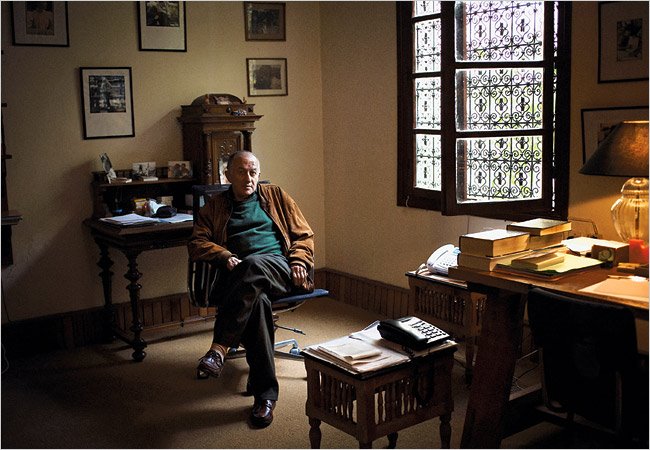
Imagine my surprise this morning when the normally uneventful stroll through the Sunday New York Times yielded this fascinating portrait of a Spanish novelist I had never heard of.Juan Goytisolo is a character lifted off the pages of a magical realist novel. He is a Spanish expatriate novelist who has lived in the Jemaa el Fna neighborhood of Marrakesh for 25 years, has a scholarly interest in Sufi Muslim thought and Arabic and Turkish grammar and is an outspoken public intellectual who regularly writes for the Spanish newspaper El Pais. His tangled sexual identity adds more color to the portrait: he is a homeosexual who lived for 40 years with a French woman he says was her only love and today shares the quarters in his Marrakesh home with two Morrocan brothers and their three children.
Here are some interesting excerpts from the profile:
"You can't understand Cervantes or Fernando de Rojas" — the presumed author of the 15th-century comedy "La Celestina" — "without knowing they were both converted Jews, on the periphery of Spanish life. The regard from the periphery to the center is always more interesting.""Struggling for a world that would be impossible for us": what a striking phrase that expresses an essentially tragic view of life. On reading this I was reminded of the lyrics of Rabbi Shergill's song "Jugni" about the emptiness of much urban life amongst the frenzied dash for material possessions.
Tariq Ali, --- describes Goytisolo as "the exact opposite of V. S. Naipaul. Naipaul came from Trinidad, a tiny colony, to the center of empire, and became an empire loyalist. Juan is trying to recover the vanished glory of an Andalusia which was destroyed by Catholicism. I'd say he's on the main track of history at the moment."
For Goytisolo, there are two worlds, and the gap between them is getting dangerously wide. There is the world he loves — the world of public storytellers, open-air cinemas and wandering saints, a world born out of an extreme poverty that both troubles and fascinates him. --- Then there is the developed world, in which elections are free and children no longer die of curable diseases but human relations are diminished, homogenized. "For many years, I've felt we were struggling for a world that would be impossible for us."
Jugni ja pohnchi Bambai
Jithe saunda koi nahin
Sab labhan cheez koi
Kisse kisse nu labhe
Jinnu labhe oh bechain
Matthe vat fir usdey painh
Friday, March 10, 2006
Edward Said remembered
Some excerpts from Bilgrami's memorial speech:
There are a very few intellectuals --–Bertrand Russell, E.P. Thompson, and Noam Chomsky come to mind in the English-speaking world--- whose writings and whose lives provide a kind of pole that thousands of people look toward so as to feel that they are not wholly lost or marginal for possessing instincts for justice and humanity, and for thinking that some small steps might be taken towards their achievement. Edward Said was, without a doubt, such a man. The daze and despair so many of us here at Columbia feel, now that we have taken in that he has gone, is only a very local sign of what is a global loss without measure. And to think of what it must be like for his own brutalized people to lose him, is unbearable.
Edward’s influence on the young came from his refusal to allow literature to offer merely self-standing pleasures. The connections he made in even our most canonical
works, between the narrations of novels and the tellings of national histories,between the assertions of an author and the assertion of power by states, between the unconscious attitudes of a seemingly high-minded writer and some subtle illiberal tendency of social or national prejudice, drew to the study of literature numberless students who, out of a quest for worldly engagement, or more simply out of a cosmopolitan curiosity, demanded just such an integrity of words with morals.
S. Asad Raza's tribute to Said on the second anniversary of his death is a touching and more personal portrait. Here Said is the beloved and brilliant teacher with great power to inspire but also to induce dread. This is the portrait of the teacher as a heroic figure that I have always found so deeply attractive. From Mr. Chips to Robin Williams in Dead Poets Society to members of my own family this noble role has had a persistent hold on my imagination.
Some excerpts:
In 2003, as a graduate student in English at NYU, I rode the subway up to Columbia each week for a seminar with Said, which turned out to be the last one he taught. Wan and bearded, Said would walk in late with a bottle of San Pellegrino in hand and proceed to hold forth, off the cuff, about an oceanic array of subjects relating to the European novel (Don Quixote, Gulliver's Travels, Sentimental Education, Great Expectations, Lord Jim, etc.), alternately edifying and terrifying his audience. He had an exasperation about him that demanded one to know more, to speak more clearly, to learn more deeply in order to please him. Some found the constant harangues too traumatic for their delicate sensibilities; I loved to have found a teacher who simply did not accept less than excellence. It was a supremely motivating, frightening, vitalizing experience. In a class on Robinson Crusoe, a fellow student became confused about the various strands of eighteenth-century non-conformist Protestantism, prompting Said to irritatedly draw a complex chart of the relations between Dissenters, Puritans, Anglicans, etc. Similar demonstrations of the sheer reserves of his knowledge occurred on the subjects of the revolutions of 1848, the history of Spanish, and the tortuous philosophical subtleties of Georg Lukacs' Theory of the Novel, among other things. Said had a whole theory of the place of nephews in literature (not the real son, but the true inheritant), and he made himself his students' challenging, agresssive, truth-telling, loving uncle.
One day, Said yelled at me publicly for misprounoucing my own name. I had Americanized its proununciation for the benefit of a visiting professor, John Richetti, who I was questioning. "Your name is Us-udth!" Said cried, "It means lion in Arabic! Never mispronounce it for their benefit!" (Richetti was an old friend of Said's and found being characterized as one of "them" highly amusing; I ran into him a year ago and we laughed about it.) Afterwards, Said walked over and put a hand on my shoulder. "Sorry about that. We can't change ourselves for anyone. Opposition," he intoned, quoting Blake, "is true friendship." That encounter marked a turn for me. I began to visit Said in his office, waiting while he took phone calls from friends like Joan Didion, and telling him about my work. He had the special ability to make one feel that one could achieve anything - maybe it helped that he set the bar so high himself. Despite his heavy criticism of my use of certain theoretical vocabularies he had moved past ("the merest decoration," he called them), the last word of his handwritten comments on my paper inspired me and continues to inspire me: "Bravo." As a favorite aphorism of his from Gramsci goes, pessimism of the intellect, optimism of the will. Yet, during this period, he would intimate to me that things were not optimistic with his health at all. One day he declined my request that he read a chapter I had written, saying only, "I don't have time. You know, Asad, I'm not well." The unsentimental, factual tone of resignation told me everything I didn't want to know.In his last decade, as the situation in Palestine and Israel worsened and beloved friends such as Eqbal Ahmed and Ibrahim Abu-Lughod died, I know Edward felt more alone in the world. With his passing, though we try to forget it, the world has equally became an emptier, lonelier place. Without the superbly contradictory, fearfully charismatic, bravely heartfelt Edward Said, it is also a far less cosmopolitan place.