The July issue of Prospect magazine has an interesting article about Muslim reformist thinkers in the West. There is also an accompanying interview with Tariq Ramadan who is a western Islamic scholar currently at Oxford. Interestingly, he is the grandson of Hassan-al-Banna, the Egyptian founder of the Muslim Brotherhood.
I have long believed that Muslim majority societies are so oppressed and intellectually stifled that it is highly unlikely that Islam's reformation will begin anywhere in the heart of the Islamic world. The intellectual vitality needed to lead Muslim thought into the 21st century will come from Muslim scholars in the west; people who are trained in intellectually curious and open societies in which free inquiry is protected and one's cozy notions are challenged in a cosmopolitan marketplace of ideas. It is people like Hamza Yusuf, Zaid Shakir (african-american imam), Tariq Ramadan, Ziauddin Sardar and Abdolkarim Soroush who are likely to lead this movement.
Sunday, June 25, 2006


Wednesday, May 17, 2006
"Those Winter Sundays" by Robert Hayden
 Today the guest on Terry Gross's NPR radio show Fresh Air was the former US poet laureate Billy Collins. He has recently collected and published recordings of poetry read by the poets themselves. Billy Collins introduced a poem called "Those Winter Sundays" by an African-American poet named Robert Hayden. It is a beautiful poem. The poem is a son's belated acknowledgement of his father's love. It is a melancholy remembrance of his youth when he is unable to penetrate the veil of appearances to understand the nature of his own father's feelings. The burdens of the father's responsibilities grind him down every day, perhaps make him bitter and angry but the love too is real, polishing shoes and driving away the cold.
Those Winter Sundays
Sundays too my father got up early
And put his clothes on in the blueback cold,
then with cracked hands that ached
from labor in the weekday weather made
banked fires blaze. No one ever thanked him.
I'd wake and hear the cold splintering, breaking.
When the rooms were warm, he'd call,
and slowly I would rise and dress,
fearing the chronic angers of that house,
Speaking indifferently to him,who had driven out the cold
and polished my good shoes as well.
What did I know, what did I know
of love's austere and lonely offices?
Tuesday, May 16, 2006
Argumentative Indians - A Conversation
I just discovered this wonderful conversation between Amartya Sen and Salman Rushdie conducted on April 30th as part of the PEN New York World Voices Festival. You can listen to the entire conversation here. 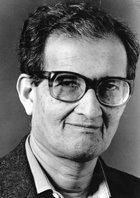
Amartya Sen is an intellectual of extraordinarily polymathic abilities. A 1998 Economics Nobel Laureate, Sen has engaged with issues that demonstrate an impressive breadth outside of his professional field of specialization. His autobiographical essay on the Nobel site is worth scanning to get both a glimpse of an awe-inspiring life and to sense the presence of a kind and decent human being. His recent book "Identity and Violence: The Illusion of Destiny" is getting widely reviewed these days and this exchange of letters with Robert Kagan on Slate about the new book demonstrates Sen's serious engagement with ideas and the criticism of his work. Ultimately what makes the exchange unsatisfying is the lack of Kagan's knowledge and preparation on the subject.
I have never read any of Sen's larger works but "The Argumentative Indian: Writings on Indian History, Culture and Identity" is on my current short list.

Amartya Sen is an intellectual of extraordinarily polymathic abilities. A 1998 Economics Nobel Laureate, Sen has engaged with issues that demonstrate an impressive breadth outside of his professional field of specialization. His autobiographical essay on the Nobel site is worth scanning to get both a glimpse of an awe-inspiring life and to sense the presence of a kind and decent human being. His recent book "Identity and Violence: The Illusion of Destiny" is getting widely reviewed these days and this exchange of letters with Robert Kagan on Slate about the new book demonstrates Sen's serious engagement with ideas and the criticism of his work. Ultimately what makes the exchange unsatisfying is the lack of Kagan's knowledge and preparation on the subject.
I have never read any of Sen's larger works but "The Argumentative Indian: Writings on Indian History, Culture and Identity" is on my current short list.
Orhan Pamuk - Freedom to Write
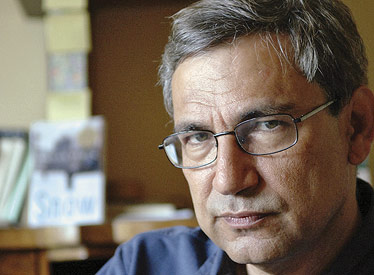 On April 25th, Orhan Pamuk gave the PEN Arthur Miller Freedom to Write Memorial Lecture at Cooper Union's Great Hall in New York. The trancript of Pamuk's lecture is reprinted in the most recent issue of the New York Review of Books. Here is a excerpt I found beautiful and was pleasantly surprised to see the same extended passage quoted by Robin Varghese on 3quarksdaily.
Excerpt:
I always have difficulty expressing my political judgments in a clear, emphatic, and strong way—I feel pretentious, as if I'm saying things that are not quite true. This is because I know I cannot reduce my thoughts about life to the music of a single voice and a single point of view --- Living as I do in a world where, in a very short time, someone who has been a victim of tyranny and oppression can suddenly become one of the oppressors, I know also that holding strong beliefs about the nature of things and people is itself a difficult enterprise. I do also believe that most of us entertain these contradictory thoughts simultaneously, in a spirit of good will and with the best of intentions --- It is because our modern minds are so slippery that freedom of expression becomes so important: we need it to understand ourselves, our shady, contradictory, inner thoughts, and the pride and shame that I mentioned earlier.
Monday, May 15, 2006
The Mute's Soliloquy - Pramoedya Ananta Toer Passes Away
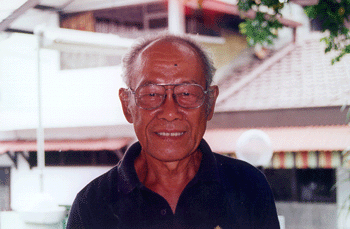 "Is it possible to take from a man his right to speak to himself?" Pramoedya Ananta Toer
Pramoedya Ananta Toer, Indonesia's greatest writer died on April 30th at the age of 81. This courageous writer spent 17 years of his life in prison during Suharto's long oppressive tenure. His great Buru Quartet (This Earth of Mankind, Child of All Nations, Footsteps, House of Glass) was written down years after he originally told the story of Indonesia's independence through the eyes of the Javanese woman Minke to his fellow prisoners night after night in captivity. His autobiography, "The Mute's Soliloquy" was published in English in 1999 and described the suffering in his prison on Buru island. Here's a tribute by Salil Tripathi in the New Statesman and an obit in The Guardian.
Saturday, May 13, 2006
Naushad - An Icon Departs
 The great music director Naushad passed away on May 5th, 2006. Naushad was arguably the finest composer in the history of Indian cinema. This is not a claim to be made lightly, for the golden era of Indian film music that started in the 40's and lasted into the 60's, produced some extraordinary talents: Master Ghulam Haider, Anil Biswas, Khemchand Prakash, Roshan, Khurshid Anwar, S.D. Burman, Jaidev, Madan Mohan, Salil Chowdhury. Even amongst these giants, Naushad's mastery in the use of classical forms in film music was unparalleled.
There is no better example of his wizardry than his songs for the film Baiju Bawra. Rafi's masterpiece "man tarpat hari darshan ko aaj" in Raga Malkauns is legendary. As the story goes, Naushad wanted Ustad Bade Ghulam Ali Khan to sing this song but he demanded a hefty amount. Naushad convinced the producer to pay this princely sum but when Naushad went back to the Ustad he doubled his original ask. At this point Naushad turned to Rafi and had him practice and rehearse diligently so he could sing this difficult song. The Ustad upon listening to Rafi's version of the song supposedly expressed admiration and acknowledged his surprise that someone outside the gharana tradition ("attai") could sing so well. There is also a great jugalbandhi on this soundtrack between Ustad Amir Khan singing as Tan Sen and Pandit D.V. Paluskar singing playback for the title character of Baiju.
Scanning the obituaries of Naushad in Indian newspapers was sadly disappointing. There was not one English newspaper that did any justice to the man's legacy or his charming, civilized personality which was reflective of old Lakhnavi tehzeeb. The Telegraph's obit had some personal reflections from people like Dilip Kumar but most pieces were a dry recitation of easily found facts. It would be heartening to see the day when great sub-continental artists finally get insightful evaluations of their lives and work, not the generic praise laced with platitudes.
Wednesday, May 10, 2006
Of Mangoes and Memories
Today's travel section in the NY Times has a story on the explosion of mango mania in Mumbai during the summer months. The story transported me to the hot summer days of my childhood and adolescence in Lahore and to the memories of feasting on the rich variety of mangoes, my mother chastising me for eating too many and chasing them down with glasses of ice cold "lassi". For Lahoris, the appearance of particular varieties of mangoes were the markers of different phases of the long, drawn out and brutally hot summer. Large, deep yellow Sindhri mangoes were the first to appear in May but the much prized varieties arrived later; Langra, Chaunsa, Saharni, Dusehri, Anwar Ratol. These distinctive names evoke stories of their provenance no longer remembered or half-forgotten places of their origin.
After coming to America in the late 80's, the new world overwhelmed the memory of mangoes along with much else. Imagine my disappointment when after spotting a mango in a supermarket in Pennsylvania and convincing myself that paying an arm and a leg was worth experiencing that little flavor of home, I tasted the insipidness of a fruit that bore no resemblance to the real thing. I gave up on mangoes in America that day but with the expected arrival of mangoes from the sub-continent, perhaps I will get to taste again a quintessential experience of my youth.
After coming to America in the late 80's, the new world overwhelmed the memory of mangoes along with much else. Imagine my disappointment when after spotting a mango in a supermarket in Pennsylvania and convincing myself that paying an arm and a leg was worth experiencing that little flavor of home, I tasted the insipidness of a fruit that bore no resemblance to the real thing. I gave up on mangoes in America that day but with the expected arrival of mangoes from the sub-continent, perhaps I will get to taste again a quintessential experience of my youth.
Sunday, May 07, 2006
Nature vs. Nurture - Freakonomics Style
Stephen Dubner and Steven Levitt's article, "A Star is Made" in the NY Times Sunday magazine argues based on research done by Anders Ericsson at FSU that talent is overrated as a predictor of performance. In practice expert performers in surgery, ballet, tennis or most any other activity are made not born. Much like their approach in their best-selling book Freakonomics (and the interesting related blog) they start with an anomalous fact ("most elite soccer players are born early in the calendar year") and their hypotheses about the answer leads them to understand the imporatnce of deliberate practice as the dominant factor in explaining performance differences.
Some excerpts:
Some excerpts:
Ericsson and his colleagues have thus taken to studying expert performers in a wide range of pursuits, including soccer, golf, surgery, piano playing, Scrabble, writing, chess, software design, stock picking and darts. They gather all the data they can, not just performance statistics and biographical details but also the results of their own laboratory experiments with high achievers.
Their work, compiled in the "Cambridge Handbook of Expertise and Expert Performance," a 900-page academic book that will be published next month, makes a rather startling assertion: the trait we commonly call talent is highly overrated. Or, put another way, expert performers — whether in memory or surgery, ballet or computer programming — are nearly always made, not born. And yes, practice does make perfect. These may be the sort of clichés that parents are fond of whispering to their children. But these particular clichés just happen to be true.
Sunday, April 16, 2006
Juan Goytisolo - A Spaniard in Marrakesh
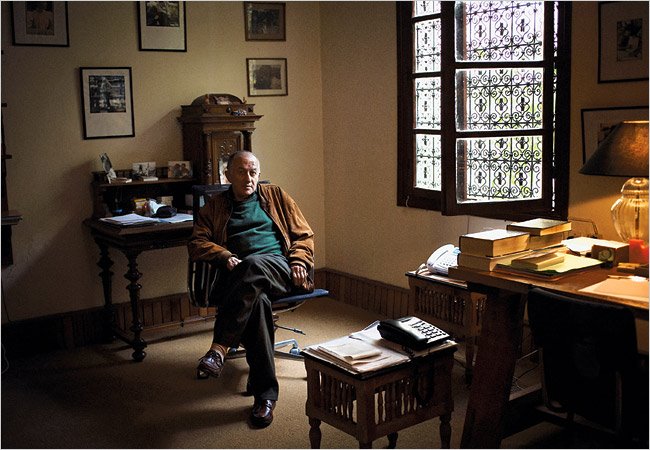 Imagine my surprise this morning when the normally uneventful stroll through the Sunday New York Times yielded this fascinating portrait of a Spanish novelist I had never heard of.
Juan Goytisolo is a character lifted off the pages of a magical realist novel. He is a Spanish expatriate novelist who has lived in the Jemaa el Fna neighborhood of Marrakesh for 25 years, has a scholarly interest in Sufi Muslim thought and Arabic and Turkish grammar and is an outspoken public intellectual who regularly writes for the Spanish newspaper El Pais. His tangled sexual identity adds more color to the portrait: he is a homeosexual who lived for 40 years with a French woman he says was her only love and today shares the quarters in his Marrakesh home with two Morrocan brothers and their three children.
Here are some interesting excerpts from the profile:
"You can't understand Cervantes or Fernando de Rojas" — the presumed author of the 15th-century comedy "La Celestina" — "without knowing they were both converted Jews, on the periphery of Spanish life. The regard from the periphery to the center is always more interesting.""Struggling for a world that would be impossible for us": what a striking phrase that expresses an essentially tragic view of life. On reading this I was reminded of the lyrics of Rabbi Shergill's song "Jugni" about the emptiness of much urban life amongst the frenzied dash for material possessions.
Tariq Ali, --- describes Goytisolo as "the exact opposite of V. S. Naipaul. Naipaul came from Trinidad, a tiny colony, to the center of empire, and became an empire loyalist. Juan is trying to recover the vanished glory of an Andalusia which was destroyed by Catholicism. I'd say he's on the main track of history at the moment."
For Goytisolo, there are two worlds, and the gap between them is getting dangerously wide. There is the world he loves — the world of public storytellers, open-air cinemas and wandering saints, a world born out of an extreme poverty that both troubles and fascinates him. --- Then there is the developed world, in which elections are free and children no longer die of curable diseases but human relations are diminished, homogenized. "For many years, I've felt we were struggling for a world that would be impossible for us."
Jugni ja pohnchi Bambai
Jithe saunda koi nahin
Sab labhan cheez koi
Kisse kisse nu labhe
Jinnu labhe oh bechain
Matthe vat fir usdey painh
Saturday, April 08, 2006
Suketu Mehta's "Maximum City"
I just started to read "Maximum City", Suketu Mehta's widely praised book about Bombay. It is a promising beginning and I hope to comment on the book in a future blog. In Mehta, the city of Bombay seems to have found an acute observer and chronicler of the multi-layered charms and exasperations of this crazy metropolis. All great cities have the capacity to marvel and horrify but not all are fortunate enough to find a writing talent adequate to the task of capturing their vibrant depth.
A quote early in the book that particularly resonated:
"Each person's life is dominated by a central event, which shapes and destroys everything that comes after it and, in retrospect, everything that came before. For me, it was going to live in America at the age of fourteen." (Suketu Mehta in "Maximum City", pg.6)
More later ----
A quote early in the book that particularly resonated:
"Each person's life is dominated by a central event, which shapes and destroys everything that comes after it and, in retrospect, everything that came before. For me, it was going to live in America at the age of fourteen." (Suketu Mehta in "Maximum City", pg.6)
More later ----
Subscribe to:
Posts (Atom)