1) I was listening this afternoon to Jonathan Franzen's interview on KQED's "City Arts & Lectures" series. His recent novel "Freedom" has received almost unprecedented literary attention a decade after the blockbuster success of "The Corrections". An audience member asked him what kind of people read serious fiction about unhappy people to which Franzen responded that literary research shows that fiction readers are typically "socially isolated" which doesn't imply that they don't have friends or semi-normal lives. It just means that these "readers" often feel a closer kinship to books and authors than they do to people around them.
2) Pankaj Mishra mentions in his op-ed piece in the New York Times today that the private wealth of 49 Indians on the Forbes list is nearly 31 percent of India’s gross domestic product. Most poor countries are likely to have similar statistics and the wealth gap is rising alarmingly even in the wealthy countries, particularly in the United Sates.When I see the images or read of the unending depredations of the wretched of the earth I often wonder how it is that the rich and the powerful are able to sustain such a patently unjust status quo. Why are the far more numerous poor and oppressed unable to mount any significant challenge to the ugly conditions they are doomed to endure because of unhappy accidents of birth?
Here's one answer via Lev Tolstoy in Tony Judt's brilliant last book "Ill Fares the Land":
"There are no conditions of life to which a man cannot get accustomed, especially if he sees them accepted by everyone around him." (Anna Karenina)
Sunday, October 03, 2010
Sunday, September 26, 2010
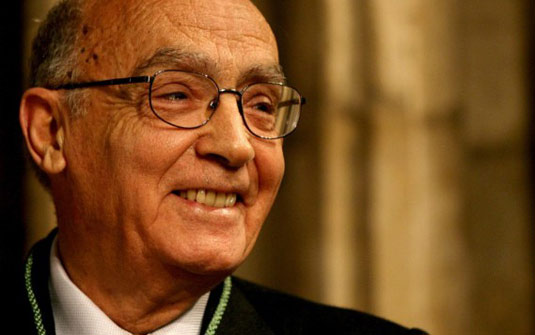
Jose Saramago - The Notebook
Jose Saramago, the Nobel-laureate Portuguese novelist, died earlier this summer at the age of 87. Fernanda Eberstadt wrote an obituary in The New York Times which also does a good job of surveying his major works. I have not read "The Year of the Death of Ricardo Reis" and "The Gospel According to Jesus Christ", the two works that are considered his masterpieces but did read the more recent "Death with Interruptions" which continued the trend of his later, more allegorical writings. In "Death with Interruptions" he imagines a country where Death decides to take a break and give humans an idea of what it would mean to have eternal life. After the initial euphoria the unbearableness of unending life and the desirability of death begins to dawn on people for reasons big and small. James Wood wrote a typically perceptive review in The New Yorker called "Death Takes a Holiday". As Wood writes in his review:
However what prompted this blog entry is that I am currently reading Saramago's collection of blog / journal entries that he wrote for a year between September 2008 and August 2009 and were published this year under the title "The Notebook". These small pieces reveal a man of luminous intelligence, acute perception, deep commitment to fairness, justice and left-wing politics and a visceral disgust for power that tramples on the dignity of human beings. Saramago never forgot the dirt poor, rural background that shaped him. Even at 86, the fire burned brightly for the man who was a member of the communist party in the darkest days of Portugal's fascist government and chose exile to the Canary Islands in 1992 on principle when his novel was blocked for a European prize by the Portuguese government under pressure from the Catholic Church.
Here are some excerpts from "The Notebook". I couldn't help read many of his observations and relate them to my own obsessions. His love letter to Lisbon would resonate with anyone who feels a similar connection to their personal Lisbon. (I substitute "Lahore" for "Lisbon" in this essay)
“awkwardnesses”—metaphysical, political, pragmatic—soon reënter. The Catholic Church is the first institution to sense a danger. The Cardinal phones the Prime Minister to point out that “without death there is no resurrection, and without resurrection there is no church.” For the Cardinal, life without death is tantamount to God’s willing His own demise. Life without death abolishes the soul. A panel of philosophers and clergymen is convened, and both sides agree that religion needs death “as much as we need bread to eat.” Life without death is like life without God, one churchman says, because “if human beings do not die then everything will be permissible.” (This is a version of the Dostoyevskian fear that without God everything is permitted.) One philosopher, sounding like the slyly secular Saramago, suggests that since death was “clearly the only agricultural implement god possessed with which to plough the roads that would lead to his kingdom, the obvious, irrefutable conclusion is that the entire holy story ends, inevitably, in a cul-de-sac.”
However what prompted this blog entry is that I am currently reading Saramago's collection of blog / journal entries that he wrote for a year between September 2008 and August 2009 and were published this year under the title "The Notebook". These small pieces reveal a man of luminous intelligence, acute perception, deep commitment to fairness, justice and left-wing politics and a visceral disgust for power that tramples on the dignity of human beings. Saramago never forgot the dirt poor, rural background that shaped him. Even at 86, the fire burned brightly for the man who was a member of the communist party in the darkest days of Portugal's fascist government and chose exile to the Canary Islands in 1992 on principle when his novel was blocked for a European prize by the Portuguese government under pressure from the Catholic Church.
Here are some excerpts from "The Notebook". I couldn't help read many of his observations and relate them to my own obsessions. His love letter to Lisbon would resonate with anyone who feels a similar connection to their personal Lisbon. (I substitute "Lahore" for "Lisbon" in this essay)
September 15th, 2008: Words for a City
"But in 1147, when the Moors were defeated after a three-month siege, the name of the city wasn't changed right away;---When did Lisboa start being Lisboa in law and in effect?---
One might think these historical minutiae uninteresting, but they interest me a great deal: not just knowing but seeing - in the precise meaning of the word - how Lisbon has been changing since those days. If cinema had existed at the time, if the old chroniclers had been cameramen, if the thousand and one changes through which Lisbon has passed over the centuries had been recorded, we would have been able to see Lisbon growing and moving like a living thing across eight centuries, like those flowers that we see on television opening up in just a few seconds, from a still, closed bud to a final splendor of shapes and colors. I think I would love that Lisbon above all else.
In physical terms we inhabit space, but in emotional terms we are inhabited, by memory. A memory composed of a space and a time, a memory inside which we live, like an island between two oceans - one the past, the other the future. We can navigate the ocean of the recent past thanks to personal memory, which retains the recollection of the routes it has traveled, but to navigate the distant past we have to use memories that time has accumulated, memories of a space that is continually changing, as fleeting as time itself. This film of Lisbon, compressing time and expanding space, would be the perfect memory of the city.
What we know of places is how we coincide with them over a certain period of time in the spaces they occupy. The place was there, the person appeared, then the person left, the place continued, the place having made the person, the person having transformed the place.
October 9th, 2008: God and Ratzinger
As I once wrote during a spell of vain metaphysical inquiry, a good fifteen years ago, God is the silence of the universe and man is the cry that gives meaning to that silence.
October 23rd, 2008: Do Torturers Have Souls?
Through my will I can determine to do or not to do something, and liberty renders me free to determine mysef one way or another. Since language has accustomed us to consider the will and liberty as inherently positive concepts, we are suddenly aware of an instinctive fear that the sparkling medals that we call liberty and will can show the complete and utter opposite on their reverse sides. It was through the use of his freedom (shocking though the use of this word might seem to us in such a context) that General Videla became, through his own will - I insist on that, through his own will - one of the most loathsome participants in the bloody and seemingly unending world history of torture and murder.--
Knowing whether or not they have souls does not matter much. In fact, the person who should know most about this subject is the Argentine Catholic priest Christian von Vernich, who a few months ago was sentenced to life imprisonment for genocide. His service record shows six murders, the torture of thirty-four people, and forty-two cases of kidnapping. And if I might be allowed a tragic irony, it is even possible that at some point he gave one of his victims the last rites....
November 7th, 2008: WordsJust as kindness should not be ashamed of being kindness, so justice should never forget that above all it is restitution, the restitution of rights. All of them, beginning with the basic right to live in dignity. If I were asked to put charity, kindness, and justice in order of precedence, I would give first place to kindness, second to justice and third to charity. Because kindness already dispenses justice and charity of its own accord, and because a fair system of justice already contains sufficient charity within it. Charity is what is left when there is neither kindness nor justice. (emphasis mine)
Tuesday, August 31, 2010
The Dark Clouds Over Pakistani Cricket
The cricket spot fixing scandal has created a deep sense of despondency amongst supporters of Pakistani cricket at home and abroad. That it comes in the midst of one of the worst natural disasters in Pakistan’s history compounds the sense of national betrayal. It is indeed fair to ask that all allegations need to be fully investigated and any guilt firmly established before any disciplinary steps are contemplated. However, most fair observers have seen enough early evidence in the “News of the World” videos and the subsequent predicted no-balls bowled by the fast bowlers to conclude that something is rotten with Pakistani cricket. This is not the first instance where Pakistan’s cricket has come under the cloud of match fixing. After the initial anger and feelings of betrayal virtually everyone is asking the question of what should be done. No observer of Pakistani cricket can have an iota of faith in PCB and its current leadership to deal with this issue in the sage and firm manner that it requires. In fact, one cannot even be sure that members of management are not themselves tainted. Nothing less than the future of Pakistan cricket is at stake.
I strongly believe that the rest of the tour should be suspended and Pakistan should voluntarily put a temporary moratorium on itself from playing international cricket until it sorts out the mess. The current PCB should be disbanded and a fully empowered investigation commission should be appointed to work through this episode expeditiously and without interference. My candidates would be respected jurists like Justice Saeed-u-Zaman Siddiqui, Fakhruddin G Ebrahim etc. along with former cricketers like Majid Khan and Zaheer Abbas. This commission should first and foremost establish facts by examining all evidence and interviewing players, coaches and management in collaboration with ACSU and ICC. It should then clearly lay out the facts in a public report as soon as possible. The report should be accompanied with clear recommendations of lifetime bans for anyone found to have involvement in spot or match fixing.
If Pakistan does not tackle this seriously and establish undiluted integrity to its cricket this cancer will never go away. For too long in Pakistani cricket all inconvenient facts have been swept under the rug, the best performers shielded from the consequences of their actions (Wasim Akram, Saeed Anwar, Waqar Younis) and even diluted Qayyum report recommendations not implemented. The result has been an ever spiraling institutional rot and rampant corruption and indiscipline. The current state of affairs is particularly terrible for those players who have resisted what seem to be ever present illegal temptations. To have any chance that players, present and future, would not have their integrity in perpetual doubt is for Pakistan’s cricket to clean the stables ruthlessly. Half-hearted measures will ensure that Pakistan cricket will always remain suspect, even if allowed into the international fold. There will be no no-ball, wide, dropped catch and loss that will escape the suspicion of corruption. Like almost everybody I feel the most sympathy for the 18-year old Mohammad Amir and I think the strongest case exists for him to get a mitigated sentence but we should remember that these are exactly the excuses that were made for Mohammad Asif in the past. We were told that he was “young, poor and uneducated” but he has demonstrated even before this episode his non-stop penchant for making mischief.
Additionally, some people have argued that spot fixing is a lesser evil than match fixing but this statement completely misunderstands the tremendous destructive effect of any illegal activity. Firstly, if there are players who have gone down the route of taking money to alter the game in a small way there is no reason for them not to keep pushing the boundary by increments if the pay-off is larger. Secondly, the distorting lens of corruption affects every decision you make as a player. If you are inside the corrupt mafia you will systematically punish people outside the circle or more likely try to exclude them from the team entirely (Rashid Latif and Basit Ali in the past, perhaps Mohammad Yousuf recently who Salman Butt did not want back in the team). You will also potentially rebel against a clean captain including underperforming to get him out (like what seems to have happened to Younis Khan in New Zealand). These are only examples. The entire behavior pattern is affected by the dynamic of illegality.
As a passionate Pakistan cricket fan, I will not be following the rest of the series if it goes ahead. I will not watch Pakistan play cricket again until I have some assurance that I am watching a clean contest. I will be waiting on the sidelines with a heavy heart until there is reasonable belief that justice has been done to those players who upheld their integrity and that the crooks have been permanently thrown out of the game.
I strongly believe that the rest of the tour should be suspended and Pakistan should voluntarily put a temporary moratorium on itself from playing international cricket until it sorts out the mess. The current PCB should be disbanded and a fully empowered investigation commission should be appointed to work through this episode expeditiously and without interference. My candidates would be respected jurists like Justice Saeed-u-Zaman Siddiqui, Fakhruddin G Ebrahim etc. along with former cricketers like Majid Khan and Zaheer Abbas. This commission should first and foremost establish facts by examining all evidence and interviewing players, coaches and management in collaboration with ACSU and ICC. It should then clearly lay out the facts in a public report as soon as possible. The report should be accompanied with clear recommendations of lifetime bans for anyone found to have involvement in spot or match fixing.
If Pakistan does not tackle this seriously and establish undiluted integrity to its cricket this cancer will never go away. For too long in Pakistani cricket all inconvenient facts have been swept under the rug, the best performers shielded from the consequences of their actions (Wasim Akram, Saeed Anwar, Waqar Younis) and even diluted Qayyum report recommendations not implemented. The result has been an ever spiraling institutional rot and rampant corruption and indiscipline. The current state of affairs is particularly terrible for those players who have resisted what seem to be ever present illegal temptations. To have any chance that players, present and future, would not have their integrity in perpetual doubt is for Pakistan’s cricket to clean the stables ruthlessly. Half-hearted measures will ensure that Pakistan cricket will always remain suspect, even if allowed into the international fold. There will be no no-ball, wide, dropped catch and loss that will escape the suspicion of corruption. Like almost everybody I feel the most sympathy for the 18-year old Mohammad Amir and I think the strongest case exists for him to get a mitigated sentence but we should remember that these are exactly the excuses that were made for Mohammad Asif in the past. We were told that he was “young, poor and uneducated” but he has demonstrated even before this episode his non-stop penchant for making mischief.
Additionally, some people have argued that spot fixing is a lesser evil than match fixing but this statement completely misunderstands the tremendous destructive effect of any illegal activity. Firstly, if there are players who have gone down the route of taking money to alter the game in a small way there is no reason for them not to keep pushing the boundary by increments if the pay-off is larger. Secondly, the distorting lens of corruption affects every decision you make as a player. If you are inside the corrupt mafia you will systematically punish people outside the circle or more likely try to exclude them from the team entirely (Rashid Latif and Basit Ali in the past, perhaps Mohammad Yousuf recently who Salman Butt did not want back in the team). You will also potentially rebel against a clean captain including underperforming to get him out (like what seems to have happened to Younis Khan in New Zealand). These are only examples. The entire behavior pattern is affected by the dynamic of illegality.
As a passionate Pakistan cricket fan, I will not be following the rest of the series if it goes ahead. I will not watch Pakistan play cricket again until I have some assurance that I am watching a clean contest. I will be waiting on the sidelines with a heavy heart until there is reasonable belief that justice has been done to those players who upheld their integrity and that the crooks have been permanently thrown out of the game.
Wednesday, July 14, 2010
"Vay MeiN Chori Chori" - ReshmaN, Meesha Shafi & Lata Mangeshkar
Coke Studio is Rohail Hyatt's innovative and extremely popular music program on Pakistani TV. Since his days as one of the original band members of Vital Signs in the early 90's he has come a long way as a highly respected and sought-after music producer who is creatively showcasing the breadth of Pakistan's indigenous music talent from well-known veterans to unfamiliar but promising young performers. Coke Studio is in the midst of its third season this summer and amongst several excellent performances thus far, Meesha Shafi's "ambient and trippy" revival of "Vay meiN chori chori" has been widely admired both for her deep, resonant voice and the quality of the vocals. In part the popularity of the song owes something to the young, attractive and charismatic presence of Meesha Shafi and the anticipation that behind the raw talent she is a potential star in the making. As the daughter of TV actress Saba Pervaiz, her performing arts pedigree is an additional marketing boon. "Vay meiN chori chori" is a revival of a song that was first performed by the virtuosic folk singer ReshmaN several decades ago. Here is Meesha Shafi's version:ReshmaN, the popular Pakistani folk singer with a stentorian voice, is best known for her raw, almost primal renditions of Punjabi and Rajasthani folk songs. She was born in Loha village in Rajasthan in 1947 in a gypsy family which moved to the Pakistani side of that desert terrain after partition. She is often reverently referred to as the "Voice of the Desert". Here is ReshmaN's version of "Chori, Chori":
While listening to Meesha Shafi's version, I felt right away that I had heard the melody before in an Indian film song. Finally, after humming a few bars I recalled that Lata Mangeshkar's wonderful song "Yara sili sili" from the film "Lekin" is the exact same composition. That 1991 film starring Vinod Khanna and Dimple Kapadia is set in Rajasthan so it is not surprising that a Rajasthani folk melody would be used. Once I went to YouTube to look at a video of "Yara sili sili" all sorts of hostile comments from internet Indians and Pakistanis unpleasantly confirmed that it is indeed the same "dhun". Personally, I think it takes nothing away from the masterful and atmospherically different song sung by Lata. The added bonus are Gulzar's lyrics. Here is Lata singing "Yara sili sili" behind Dimple Kapadia's moving lips:
Photo: A young ReshmaN
Sunday, April 25, 2010
Excerpts from Saul Bellow's Letters
In the New Yorker's April 26th, 2010 issue there is a selection of Saul Bellow's letters to other authors of his acquaintance entitled "Among Writers". I found many of Bellow's observations on life and letters thought provoking. Here are some excerpts:
"You were engaged, as a writer should be, in transforming yourself. When I read your collected stories I was moved to see the transformation taking place on the printed page. There's nothing that counts really except this transforming action of the soul. ---
Up and down on these rough American seas we've navigated for so many decades; we've had our bad trips too-unavoidable absurdities, dirty weather, but that doesn't count really. I've been trying to say what does count...."
(To John Cheever: December 9th, 1981)
"...losing a parent is something like driving through a plate-glass window. You didn't know it was there until it shattered, and then for years to come you're picking up the pieces-down to the last glassy splinter.
Of course you are your father, and he is you. I have often felt this about my own father, whom I half expect to see when I die. But I believe I do know how your father must have felt, sitting at his typewriter with an unfinished novel. Just as I understand your saying that you are your dad. With a fair degree of accuracy I can see this in my own father. He and I never seemed to be in rapport: our basic assumptions were very different. But that now looks superficial. I treat my sons much as he treated me: out of breath with impatience, and then a long inhalation of affection."
(To Martin Amis: March 13th, 1996)
"I don't do much of anything these days and I spend much of my time indoors. By far my pleasantest diversion is to play with Rosie, now four years old. It now seems to me that my parents wanted me to grow up in a hurry and that I resisted, dragging my feet. They (my parents, not my feet) needed all the help they could get. --- We often stopped before a display of children's shoes. My mother coveted for me a pair of patent-leather sandals with an elegantissimo strap. I finally got them - I rubbed them with butter to preserve the leather. This is when I was six or seven years old, a little older than Rosie is now. Amazing how it all boils down to a pair of patent-leather sandals."
(To Eugene Kennedy: February 19th, 2004)
Friday, April 09, 2010
Allama Iqbal in Heidelberg
For a few years now I have worked for a European company headquartered near Heidelberg in Germany so I have had an opportunity to visit this lovely, historic city several times. Heidelberg is a beautiful town located on the banks of the river Neckar which originates in the Black Forest and flows into the river Rhine only 12 miles northwest of the city.
But before I had ever been to Heidelberg, the city was associated in my mind with the great poet-philosopher Allama Muhammad Iqbal. Iqbal left Bombay for London by ship in September 1905 to attend Cambridge University. He enrolled at Trinity College and eventually received a B.A degree. From Cambridge, Iqbal went to Germany to pursue a Ph.D in Philosophy and studied in Heidelberg and Munich. It seems amazing but the exact chronology of Iqbal's stay in Germany has not been established. Most likely he was in Germany during 1906 and 1907. Sometime in 1907, under the supervision of Professor Dr. Friedrich Hommel, Iqbal submitted his Ph.D thesis titled "The Development of Metaphysics in Persia" to the Ludwig Maximilians University at Munich and was granted a doctorate.
There is a fascinating piece written by M.A.H. Hobohm called "Muhammad Iqbal and Germany" in which he provides some wonderful details of Iqbal's stay in Heidelberg. This essay is worth reading in its entirety. Iqbal stayed for some time in the "Pension Scherer" which was a boarding house for foreign students. At this boarding house Miss Emma Wegenast was Iqbal's German language tutor. Iqbal corresponded with Fraulein Wegenast for several years after returning to Lahore. Hobohm has copies of 27 such letters which includes 2 postcards and this collection reveals Iqbal's fondness for his former tutor but also his love for German literary culture and his affection for Heidelberg. Hobohm provides some wonderful quotes from the letters:
"Here it is: Fraulein Wegenast, that is Goethe, Heine, Kant and Schopenhauer, it is Heidelberg, the Neckar, Germany —it is those happy days!"
"It is impossible for me to forget your beautiful country where I have learned so much. My stay in Heidelberg is nothing now but a beautiful dream. How I’d wish I could repeat it!"
"I’d wish I could see you once more at Heidelberg or Heilbronn whence we shall together make a pilgrimage to the sacred grave of the great master Goethe."
This brings me back to my own visits to Heidelberg where I have occasionally tried to retrace Iqbal's steps. I have wandered the halls of the philosophy department at the University of Heidelberg where he studied. Normally I stay at the Marriott Hotel in Heidelberg and "Iqbal Ufer", the street honoring the great poet, is right across from that hotel and a constant reminder of the philosopher-poet's years of association with this city. "Ufer" means river bank in German and this location is right on the river Neckar. All Things Pakistan has done a post about this location in the past. However a colleague of mine, knowing my interest in Iqbal, just sent me a couple of rare photographs of the house where Iqbal lived in Heidelberg and where a sandstone plaque from 1966 acknowledges the historic landmark.
The plaque reads:
Mohammad Iqbal
1877 – 1938
1877 – 1938
National Philosopher, Poet
and Spiritual Father of Pakistan
lived here in the year 1907.
This honorary plaque was displayed on September 16th, 1966 by the minister of cultural affairs of the state of Baden Wuerttemberg Prof. Dr. Wilhelm Hahn in the presence of His Excellency the Ambassador of Pakistan Abdurrahman Khan and the 1st mayor of the city of Heidelberg, Georg Klemm.
Picture of the house with the plaque on the brick wall
Aik Shaam
(Darya-e-Neckar (Heidelberg) ke kinare par)
Khamosh hai chandni qamar ki
ShaakheiN haiN khmosh har shajar ki
Waadi ke nawa farosh khamosh
Kohsaar ke sabz posh khamosh
Fitrat behosh ho gai hai
Aaghosh maiN shab ke so gayee hai
Kuch aisa sakoot ka fasooN hai
Neckar ka kharam bhi sakooN hai
TaaroN ka khmosh kaarvaaN hai
Yeh kafila be dara rawaN hai
Khamosh haiN koh-o-dasht-o-darya
Qudrat hai muraqbe maiN goya
Aye dil! tu bhi khmosh ho ja
Aaghosh maiN gham ko lay ke so ja
Update: September 20th, 2012:
Much to my delight I found a beautifully done video on YouTube by Dr. Homayun Shirzadeh reciting "Aik Shaam". The video has lovely images of Heidelberg evoking Iqbal's poetic imagery and includes English and German ("Ein Abend") translations of the poem. Here it is:
Wednesday, April 07, 2010
Tony Judt's Reflections - "Death be not Proud"
With a short essay entitled "Night" in the January 14th, 2010 issue of the New York Review of Books Tony Judt, the British, Jewish NYU historian and prominent public intellectual, began writing a series of short reflections that he likely expects to be a coda to his remarkable intellectual life. I have blogged about Tony Judt before here and here and have long admired him for his intellectual acuity and moral courage. But these series of memoirs are a startling revelation even for a long time fan.
In 2008 Tony Judt was diagnosed with ALS (amyotrophic lateral sclerosis) or Lou Gehrig's disease. This deadly motor neuron disease causes the nervous system to degenerate overtime with patients eventually losing their ability to move their bodies even as their mind continues to function normally. Since October 2009, Judt has been paralyzed from the neck down and breathing through a respirator. His voice is now so weak that he can be heard only through an amplifier. In "Night", he vividly describes the experience of losing control over his body and he continues to write with the help of an assistant who transcribes his dictation. As he comes to terms with his approaching mortality, Judt's equanimity, thoughtfulness and his luminous intellect are inspirational.
Since the initial discussion of his illness in "Night", Tony Judt's short reflective essays have been entitled "Joe" , "Bedder" , "Kibbutz" , "Revolutionaries" , "Food" , "The Green Line" , "Saved by Czech" , "Paris was Yesterday" , "In Love with Trains" , "Edge People" , "Lord Warden" and "Work". (Only Kibbutz, Food and Edge People have links to the full essays on the NYRB site.) I particularly identify with "Edge People" as I count myself among them.
Excerpts from "Edge People":
Interview Excerpts:
In 2008 Tony Judt was diagnosed with ALS (amyotrophic lateral sclerosis) or Lou Gehrig's disease. This deadly motor neuron disease causes the nervous system to degenerate overtime with patients eventually losing their ability to move their bodies even as their mind continues to function normally. Since October 2009, Judt has been paralyzed from the neck down and breathing through a respirator. His voice is now so weak that he can be heard only through an amplifier. In "Night", he vividly describes the experience of losing control over his body and he continues to write with the help of an assistant who transcribes his dictation. As he comes to terms with his approaching mortality, Judt's equanimity, thoughtfulness and his luminous intellect are inspirational.
Since the initial discussion of his illness in "Night", Tony Judt's short reflective essays have been entitled "Joe" , "Bedder" , "Kibbutz" , "Revolutionaries" , "Food" , "The Green Line" , "Saved by Czech" , "Paris was Yesterday" , "In Love with Trains" , "Edge People" , "Lord Warden" and "Work". (Only Kibbutz, Food and Edge People have links to the full essays on the NYRB site.) I particularly identify with "Edge People" as I count myself among them.
Excerpts from "Edge People":
As an English-born student of European history teaching in the US; as a Jew somewhat uncomfortable with much that passes for "Jewishness" in contemporary America; as a social democrat frequently at odds with my self-described radical colleagues, I suppose I should seek comfort in the familiar insult of "rootless cosmopolitan." But that seems to me too imprecise, too deliberately universal in its ambitions. Far from being rootless, I am all too well rooted in a variety of contrasting heritages.
In any event, all such labels make me uneasy. We know enough of ideological and political movements to be wary of exclusive solidarity in all its forms. One should keep one's distance not only from the obviously unappealing "-isms"—fascism, jingoism, chauvinism—but also from the more seductive variety: communism, to be sure, but nationalism and Zionism too ---
I prefer the edge: the place where countries, communities, allegiances, affinities, and roots bump uncomfortably up against one another—where cosmopolitanism is not so much an identity as the normal condition of life. Such places once abounded. Well into the twentieth century there were many cities comprising multiple communities and languages—often mutually antagonistic, occasionally clashing, but somehow coexisting. Sarajevo was one, Alexandria another. Tangiers, Salonica, Odessa, Beirut, and Istanbul all qualified—as did smaller towns like Chernovitz and Uzhhorod.
Unlike the late Edward Said, I believe I can understand and even empathize with those who know what it means to love a country. I don't regard such sentiments as incomprehensible; I just don't share them. But over the years these fierce unconditional loyalties—to a country, a God, an idea, or a man—have come to terrify me. The thin veneer of civilization rests upon what may well be an illusory faith in our common humanity. But illusory or not, we would do well to cling to it. Certainly, it is that faith—and the constraints it places upon human misbehavior—that is the first to go in times of war or civil unrest.On March 29th, 2010 Terry Gross interviewed Judt on her NPR program Fresh Air. I highly recommend listening to this 39 minute interview. I can only wish that more of us possessed Judt's vivid powers of observation and language and his contemplative grace in the face of extreme adversity.
Interview Excerpts:
On his religious views:
"I don't believe in an afterlife. I don't believe in a single or multiple godhead. I respect people who do, but I don't believe it myself. But there's a big 'but' which enters in here. I am much more conscious than I ever was — for obvious reasons — on what it will mean to people left behind once I'm dead. It won't mean anything for me. But it will mean a lot to them. It's important to them — by which I mean my children or my wife or my very close friends — that some spirit of me is in a positive way present in their lives, in their heads, in their imaginations and so on. So [in] one curious way I've come to believe in the afterlife — as a place where I still have moral responsibilities, just as I do in this life — except that I can only exercise them before I get there. Once I get there, it will be too late. So, no God. No organized religion. But a developing sense that there's something bigger than the world we live in, including after we die, and we have responsibilities in that world."
On how living with ALS makes him feel:
"You mustn't focus on what you can't do. If you sit around and think, 'I wish I could walk,' then you'll just be miserable. But if you sit and turn around and think, 'What's the next piece I'm going to write?' then you may not be happy, but you certainly won't wallow in misery. So it's an active choice every day to renew my interest in something that my head can do, so I don't think about the body."
Sunday, April 04, 2010
"Toomba" and "Aik Alif" - The Brilliant SaieeN Zahoor at the Coke Studio
SaieeN Zahoor is a Pakistani Sufi musician who has spent his life singing at Sufi shrines in Punjab and Sindh. He has become a household name relatively recently thanks to Rohail Hyatt's brilliantly produced program of fusion music called "Coke Studio". Here are two wonderful "Coke Studio" performances by SaieeN Zahoor; "Toomba" is a solo performance and "Aik Alif" is with the talented duo Noori (Ali Noor and Ali Hamza).
Sunday, January 17, 2010
Farida Khanum Singing Raga Kamod - Manna for the Soul
The internet is a remarkable treasure trove and I continue to marvel at the doors of culture, information and connectivity that it has opened. My recent discovery is a wonderful collection of Hindustani Classical music on the file sharing site esnips. I have been spending hours listening to pieces I love and discovering unknown treasures of the sub-continent's greatest vocalists.
Here's my selection of the day; Farida Khanum singing Raga Kamod. This is unfortunately the kind of performance by the the sister of Mukhtar Begum and a disciple of Ustad Ashiq Ali Khan (son of the founder of the Patiala Gharana Ustad Fateh Ali Khan, one half of the legendary duo Aliya Fattu) that Pakistani audiences have witnessed only rarely. In a country with almost no appetite for classical music she shifted her focus to lighter forms of singing decades ago.
Raga Kamod by Farida Khanum:
P.S. Here is an excellent article on Ustad Ashiq Ali Khan in the online classical music magazine Sadarang. There is also a wonderful personal recollection by Mr. M.A. Sheikh of Ustad Bade Ghulam Ali Khan's "shakkar" ceremony at Takia Meerasian in Lahore in 1932/33. At this event Bade Ghulam Ali Khan honored his two Patiala Gharana gurus, Ustad Ashiq Ali Khan and Ustad Akhtar Hussain Khan (father of Fateh Ali/Amanat Ali).
Here's my selection of the day; Farida Khanum singing Raga Kamod. This is unfortunately the kind of performance by the the sister of Mukhtar Begum and a disciple of Ustad Ashiq Ali Khan (son of the founder of the Patiala Gharana Ustad Fateh Ali Khan, one half of the legendary duo Aliya Fattu) that Pakistani audiences have witnessed only rarely. In a country with almost no appetite for classical music she shifted her focus to lighter forms of singing decades ago.
Raga Kamod by Farida Khanum:
|
P.S. Here is an excellent article on Ustad Ashiq Ali Khan in the online classical music magazine Sadarang. There is also a wonderful personal recollection by Mr. M.A. Sheikh of Ustad Bade Ghulam Ali Khan's "shakkar" ceremony at Takia Meerasian in Lahore in 1932/33. At this event Bade Ghulam Ali Khan honored his two Patiala Gharana gurus, Ustad Ashiq Ali Khan and Ustad Akhtar Hussain Khan (father of Fateh Ali/Amanat Ali).
Wednesday, December 30, 2009
Bruce Springsteen Tribute at "The 32nd Annual Kennedy Center Honors"
The Kennedy Center in Washington D.C., which opened in September 1971, is one of America's premier arts facility and features thousands of performances by the greatest artists from America and across the world every year.
It is best known for its recognition of the lifetime contribution of some of America's greatest artists through the prestigious Kennedy Center Honors. This year for the 32nd Annual Kennedy Center Honors the Center honored Mel Brooks (actor, writer, director), Dave Brubeck (pianist, composer), Grace Bumbry (opera singer), Robert DeNiro (actor, director) and Bruce Springsteen (singer, songwriter). The honorees come to the Center and are presented by many of their peers with heartfelt tributes honoring their life's work. This event is televised and this year's event was shown on CBS on December 29th.
I was particularly moved this year by the wonderful tribute performances of legendary Bruce Springsteen songs by some exceptional artists : John Mellencamp ("Born in the USA"), Ben Harper / Jennifer Nettles ("I'm on Fire"), Melissa Etheridge ("Born to Run"), Eddie Vedder of Pearl Jam ("My City of Ruins") and Sting ("The Rising"). Here are the performances in two separate exceptionally good quality video clips:
Part 1:
Part 2:
It is best known for its recognition of the lifetime contribution of some of America's greatest artists through the prestigious Kennedy Center Honors. This year for the 32nd Annual Kennedy Center Honors the Center honored Mel Brooks (actor, writer, director), Dave Brubeck (pianist, composer), Grace Bumbry (opera singer), Robert DeNiro (actor, director) and Bruce Springsteen (singer, songwriter). The honorees come to the Center and are presented by many of their peers with heartfelt tributes honoring their life's work. This event is televised and this year's event was shown on CBS on December 29th.
I was particularly moved this year by the wonderful tribute performances of legendary Bruce Springsteen songs by some exceptional artists : John Mellencamp ("Born in the USA"), Ben Harper / Jennifer Nettles ("I'm on Fire"), Melissa Etheridge ("Born to Run"), Eddie Vedder of Pearl Jam ("My City of Ruins") and Sting ("The Rising"). Here are the performances in two separate exceptionally good quality video clips:
Part 1:
Part 2:
Subscribe to:
Posts (Atom)